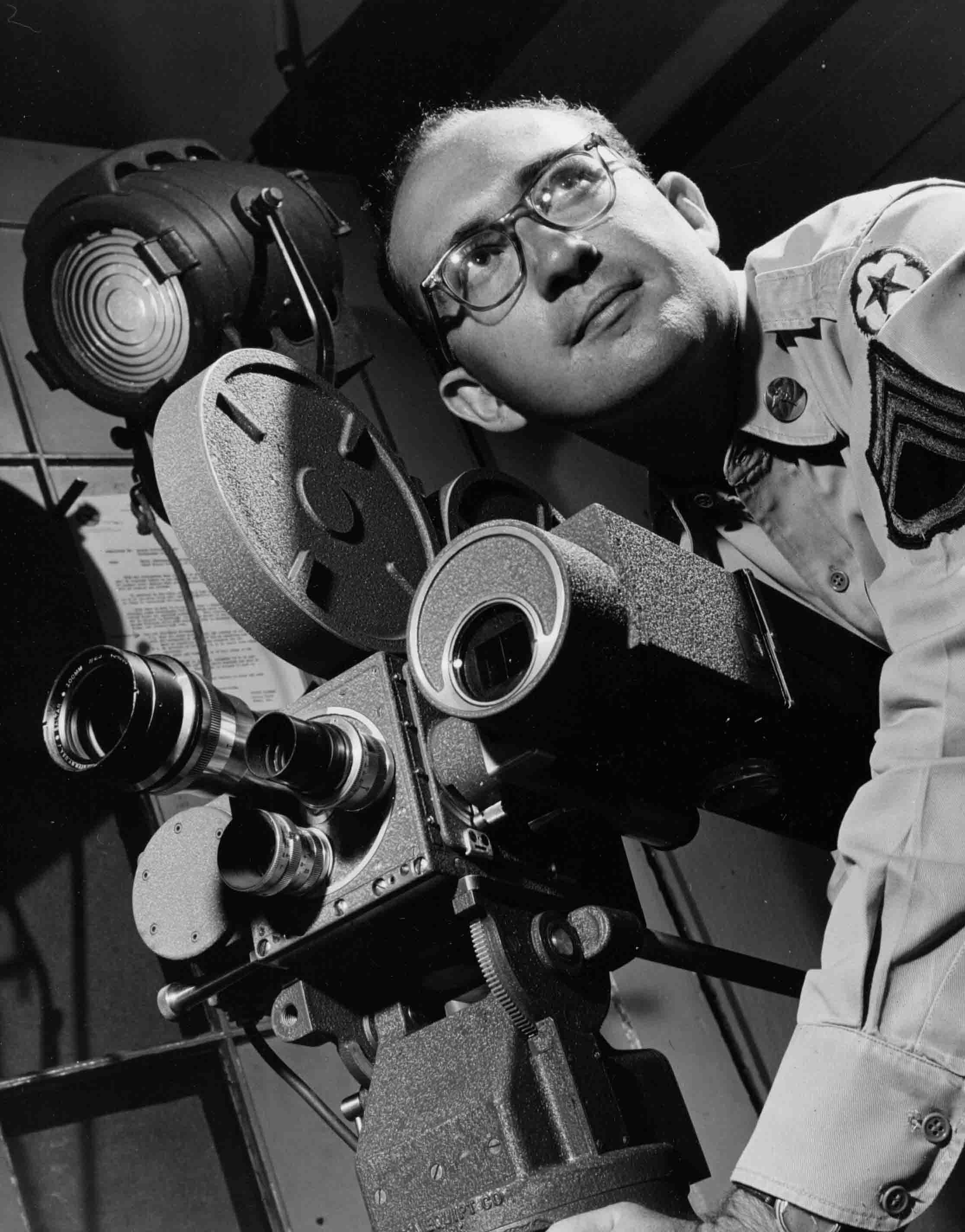
Sid Milstein in Korea, c. 1953
Over the course of 45 years as a producer, director, cinematographer and
editor, Sidney Milstein made approximately 500 documentary films. His company, Aegis Productions,
which he started in New York City in 1963, specialized in the production of
medical education films but also produced films on subjects including fashion,
teacher training and public safety. The most prestigious award Sid received was
the Columbus Film Festival's Best Film of the Year award for a documentary on
high blood pressure produced for the World Heath Organization called 'If Only It
Hurt A Little.'
Born (May 30, 1928) and raised in the Bronx, Sid was the youngest of four children. His father
worked as a carpenter. Sid first became interested in making movies at the age
of 12 when a cousin gave him a used DeVry single lens 16mm camera. He bought
off-brand film trims for $1 a roll and began shooting footage of his family.
As a teen, Sid got a part-time job at Universal Pictures as an office assistant
responsible for delivering promotional material to movie theaters in New York
City. In his spare time, he would wander over to the next door office to watch
the Universal editors put together newsreels from live footage shot all over the
world. "That was right at the height of World War II," Sid recalled. "I'd see
all this footage from the war and from the concentration camps. I would stand
with the editor and watch how he put the reel together. I was fascinated by
seeing how he took a whole bunch of different images and put them together into
a cohesive document that had much more meaning than a collection of its separate
parts."
After graduating from high school, Sid was offered a fulltime job at Universal
Pictures in the booking department but he chose to continue his education at
City College of New York. Never imagining how he might turn his fascination with
film into a career, he majored in biochemistry, expecting to find work at a
pharmaceutical company after graduation. But, during his junior year, he took a
hands-on film production class taught by German art filmmaker Hans Richter.
Richter had recently immigrated to the U.S. and was head of City College's
Institute of Film Technique. Through the film school, Sid met some of the
best-known documentary filmmakers of the time. Teaching along with Richter were
Leo Seltzer, who later won an Academy Award, renowned editor Sidney Meyers, and
director George L. George.
One film class led to another, and Sid began to see how he might be able to make
a living pursuing his passion. Following graduation, Sid accepted Richter's
offer to stay on at City College as Richter's assistant in the film school.
Although fascinating, the job at City College was low paying. After six months,
Sid told Richter he needed to make a higher wage. Richter introduced Sid to
filmmaker Dwinell Grant whose production company, Sturgis-Grant, was looking for
an animation cameraman.
Sid recalled that he had had no experience shooting animation prior to taking
the job at Sturgis-Grant. On the way to his interview with Dwinell Grant, he
stopped off at the New York Public Library to read up on the subject. The only
book he could find was one about Disney animation. He quickly learned the names
of the various animation techniques and headed off to the interview. When
Dwinell Grant asked him what he knew about animation, Sid began dropping
technical terms from the library book he had just skimmed. As Sid recalled, "Dwinell
was impressed. He said, 'Oh we don't do anything as complicated as that.'" Sid
got the animation job. But less than a year later, the Korean War broke out,
and, in 1951, Sid was drafted into the Army.
The Army first assigned Sid to work as a photographer at the Armed Forces
Institute of Pathology in Washington, D.C. There, he served as assistant
cameraman on a series of films shot at Walter Reed Hospital about obstetrical
procedures used in difficult births. The films were used to train military
physicians stationed at remote bases throughout the world. Sid later was sent to
Korea as a combat cameraman with Operation BOAR, an acronym for Body Armor.
Operation BOAR was a multidisciplinary mission aimed at evaluating the
effectiveness of armored vests worn by soldiers in combat. The mission was based
out of the famous 8055 MASH unit that was the subject of the eponymous book and
movie. Sid's role in Operation BOAR was to document through still photography
and motion pictures how the vests were worn by soldiers and damaged during
combat. In Korea, Sid recalled that he filmed hundreds of autopsies of soldiers
killed in battle. " After that I had no qualms about photographing any kind of
medical subject," he recalled.
Sid got out of the Army in 1953, and returned to Sturgis-Grant as an experienced
cinematographer. He also took classes at New York University at night, and
earned a Master's degree in Mass Communications. In 1960, he was named
production manager for Sturgis-Grant. Three years later, he left Sturgis-Grant
to start Aegis Productions. Sid and his wife, Barbara, started the company with
a modest investment. Work poured in immediately from contacts Sid had made while
working at Sturgis-Grant. Aegis' earliest productions included films on such
varied subjects as men's fashion, the settlement of Israel and kidney disease.
Before long Aegis outgrew its offices. The company moved into a larger space
that could accommodate an animation studio. More employees were hired, and Aegis
was off to a strong start. Later productions included a CINE-award-winning film
on railroad safety called 'The Right Track,' that was translated in Spanish and
French, and, at one time, was required viewing for all Canadian schoolchildren.
Aegis also produced a 10-film series for Norwich Pharmacies called 'Visits in
Urology,' which was used to train urologists in surgical procedures.
Sid also produced five films animated by Philip Stapp,
'The Sea Within Us, 1976), and four titles in the 'High Blood Pressure' series of 1979.
In 1976, Aegis Productions moved into its own building at 144 East 39th Street.
The brownstone included studio space, editing facilities and an animation
studio. At its height, the company employed about 15 employees and produced
about 50 films a year. Aegis Productions' films received awards at all of the
various medical film festivals. Sid also was the cinematographer on a feature
film, a race car adventure called 'The Daredevil,' starring George Montgomery
and Terry Moore.
During the 1980s, when technology shifted from 16mm film to video, Aegis'
business began slowing down. By then Sid was close to 60 and was unwilling to
commit the funds it would have taken to convert his entire operation to video.
By 1990, Sid had closed the company, donating much of his equipment to the film
school at NYU, and had sold the building.
In January, 2007, he donated his film collection to the Academic Film Archive of
North America with assistance from daughter Laura Milstein.
Sid spent his final years in Jupiter, Florida, and
passed away on
December 3, 2015.
- Thanks to daughter Susan Milstein, who wrote this biography.
Filmography
"Sid was so busy making films, he never compiled a filmography," Susan
Milstein tells us. As the holder of Sid's film archive, the Academic Film
Archive of North America has compiled this filmography of known
Milstein-produced films:
American Home Assurance Company (1980?)
Ballad of the A.U.A. (1977) Here, folksinger Oscar
Brand narrates and sings a ballad listing the names of all past presidents of
the American Urological Association. Film was made for 75th Anniversary year.
Bronchiospasm (1968?)
Buprenophine and the Analgesic Ideal (1985)
Cancer Chemotherapy (Solid Tumors) (1969)
Challenge Accepted: Story of the Development of Arterial
Grafts of Bovine Origin (1978)
Chronic Leukemias: Diagnosis and Management (1975)
Collateral Circulation Following Experimental Gradual
Coronary Occlusion (1960?)
Contraception Yesterday and Today (1978)
COTY American Fashion Critics Awards (1965)
Diagnosis & Management of Juvenile Rheumatoid Arthritis
(1978)
Diagnosis & Treatment of Cerebral Vascular Insufficiency
(1985?)
Diagnosis & Treatment of Malignant Hyperthermia Crisis
(1985)
Differential Diagnosis of Chest Pain (1967)
Dream and the Deed (1971)
Drive to be Number One, The (1975?)
Dynamics of the Heart (1985?)
Early Detection of Colorectal Cancer (1976)
Effects of High Energy Shockwaves on Renal Calculus (1980?)
Enternal Hyperalimentation: Techniques of Intubation
(1968?)
Essence of it All, The (1962)
Evaluation & Treatment of Impotence with the Jones Penile
Prosthesis (1980?)
Fashion and the Stars (1968?)
Fashion Horizons U.S.A. (1965)
Flexible Fiberoptic Sigmoidoscopy: Office Procedure (1975?)
Focus on Women (1980)
Golden Hour. The (1985)
Hiatus Hernia (1980?)
Hiatus Hernia: Current Concepts in Diagnosis & Treatment
(1969)
Hidden Asthmatic, The (1977)
High Blood Pressure: A Game of Chance (1978)
High Blood Pressure: If Only It Hurt a Little (1978)
High Blood Pressure: What it Is, What you Can Do About It
(1978)
Hormone Therapy for Advanced Cancer (1967)
Human Chlamydial Infections Pt. II: Salpingitis-
Chlamydial Infection in the Newborn (1985?)
Ileal Sleeve for the Dilated or Adynamic Ureter (1966)
Interpretation of Pain (1978)
In the American Tradition: the Hadassah Story (1963)
Malignant Hypothermia: the Clinical Syndrome (1978?)
Man Who Invented the World of Today, The: Thomas A. Edison
(1976)
Management of Urinary Bladder Drainage (1980?)
Mechanisms of Action of the Oral Contraceptives (1966)
Mild Analgesic Therapy for Problem Patients (1973)
Modern Concepts of Epilepsy (1956)
Needle Catheter Jejunostomy (1984)
Obese Patient, The (1980?)
1-2-3 Jackpot (1965?)
Peggy Fleming for the Kidney Foundation (1976)
Perspective on Youth Aliyah: An Investment in Life (1964)
Physiology and the Emotions in the Mature Woman (1973)
Prostate: a Patient's View (1978)
Quality of Survival (1976)
Radical Retropubic Prostatectomy & Cystoprostatectoy:
Surgical Technique (1984)
Respiratory Rehabilitation: a Comprehensive Approach
(1980?)
Revocable Trust: An Essential Tool for the Practicing
Lawyer (1966)
Right Track, The (1970)
Schools for Today and Tomorrow (1970?)
Search at Schering (1967)
Self-Examination of the Testes (1975)
Sexual Impotence in the Male: The Tragedy of the Bedroom
(1980)
Shock (1975?)
Shock: Physiochemical Rationale of Treatment (1970?)
Silent Kidney: the Importance of the Ascending Urinary
Infection (1964)
Technique & Development of the Camey Continent Ideal
Bladder (1986)
This is Chemstrand (1980)
Thyroid Cancer: Diagnosis and Treatment (1969)
Time for Caring A,: Understanding & Managing Disruptive
Behavior in the Elderly Patient (1981)
Trauma Management: Critical Interaction (1985)
Update on the Diagnosis and Management of Genital Herpes
(1983)
Urological Catheter Identification (1979)
Visits in Urology: Surgery of Renal Calculi (1976)
Water Soluble Cervical Myelography via Lumbar Injection
(1984)
Way Out, A (1970?)
When Fire Strikes (1977)