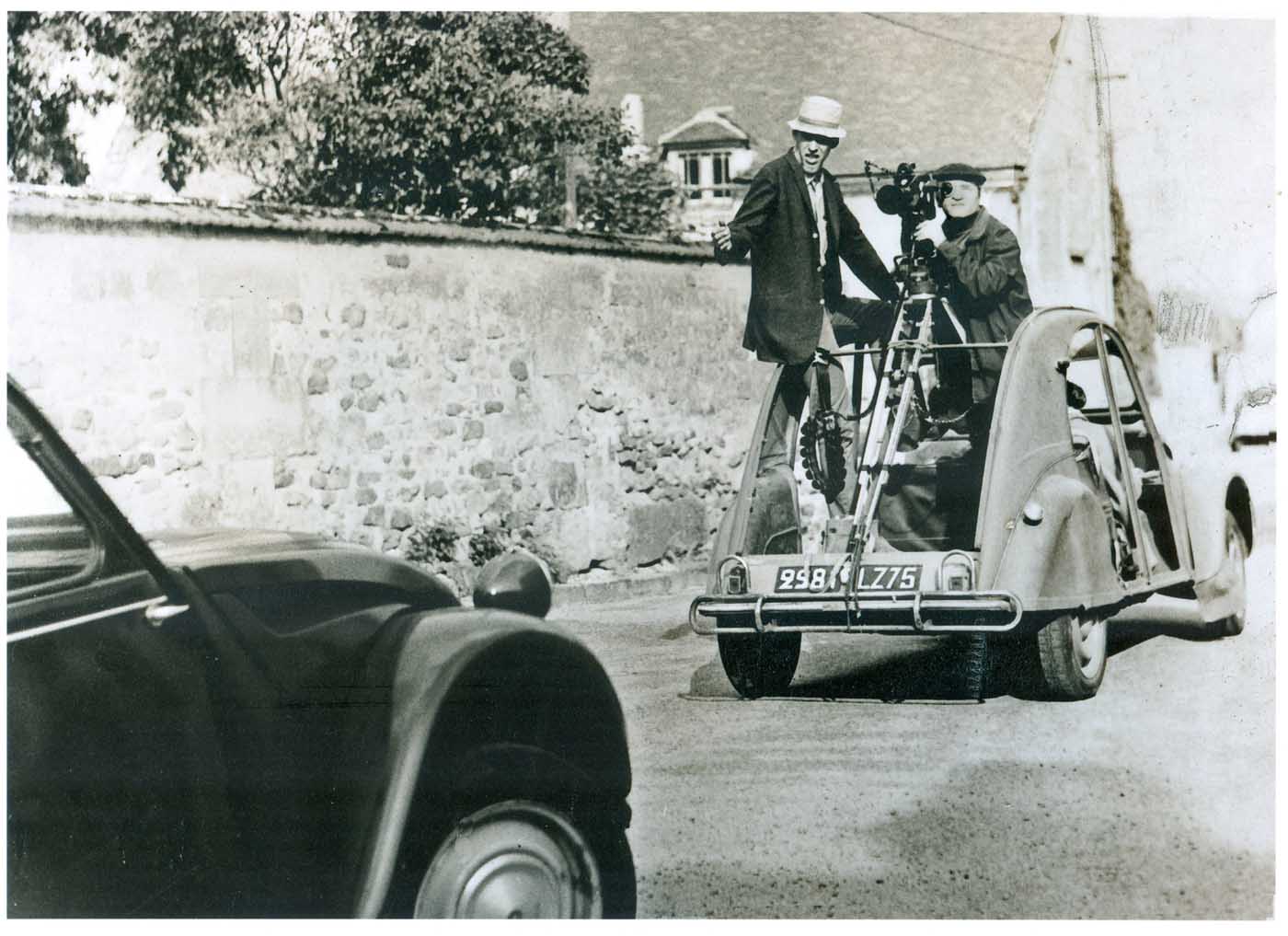
Yust (L) and Isidore Mankofsky dollying from a Deux
Cheveaux on the set of 'My Old Man'
Listen to Geoff
Alexander's 1997 interview with Larry Yust
Larry Yust's most significant contribution to educational film was
through a finely crafted, intriguing, and intellectually stimulating series of
dramatic films made for Encyclopaedia Britannica from roughly 1965-1975. Yust's
'Short Story Showcase' films are, we feel, one of the three great
serial dramatic bodies of work of the 1965-1985 era of educational film, the
others being the Robert Geller-produced "American Short Story"
distributed by Perspective Films, and the fine continual series of dramatic
films done by John Barnes from approximately 1959 through 1975. In
addition to his film work, Yust is an accomplished photographer, as evidenced by
his book Salvation Mountain: the Art of Leonard Knight
(1998 New Leaf Press, ISBN 0-9660778-9-X).
 Today, Yust continues to be engaged in new photography projects. His
latest work involves photographic elevations, which "[are] made by moving
in a line parallel to the face of the subject - walking on the opposite sidewalk
of a Los Angeles street, or crouching at the rail of a Vaporetto traveling down
the Grand Canal in Venice and snapping overlapping shots, with the camera always
aimed directly at the subject on a line perpendicular to its face. Recording the
images fifteen or thirty for each Elevation takes minutes. Fitting them together
in the computer into a single image takes longer, typically two or three days of
exacting work." These powerful images can be seen at: http://www.whatinternational.com/photos/photos.html
His book, Metro: Photographic Elevations of Selected Paris Metro
Stations was published by Ginko Press in 2004, where each open out into
a three-foot wide panorama. His work was exhibited in the Louvre in
2005. Visit his website for
more on his photos.
Today, Yust continues to be engaged in new photography projects. His
latest work involves photographic elevations, which "[are] made by moving
in a line parallel to the face of the subject - walking on the opposite sidewalk
of a Los Angeles street, or crouching at the rail of a Vaporetto traveling down
the Grand Canal in Venice and snapping overlapping shots, with the camera always
aimed directly at the subject on a line perpendicular to its face. Recording the
images fifteen or thirty for each Elevation takes minutes. Fitting them together
in the computer into a single image takes longer, typically two or three days of
exacting work." These powerful images can be seen at: http://www.whatinternational.com/photos/photos.html
His book, Metro: Photographic Elevations of Selected Paris Metro
Stations was published by Ginko Press in 2004, where each open out into
a three-foot wide panorama. His work was exhibited in the Louvre in
2005. Visit his website for
more on his photos.
Biographical notes and filmography
Yust, whose father Walter was the editor of the Encyclopaedia Britannica, was
exposed to films (and filmmakers) at an early age, when his father took him to
Hollywood on a business trip for the purpose of collecting data on the film
industry for the encyclopaedia. Later attending Stanford University as a drama
major, he became involved with the theatre department, singing first Gilbert and
Sullivan, then onto contemporary musicals. He also developed an interest in
set design, lighting, and directing. After military duty (television programming
with Walter Reed Army Hospital as part of the Signal Corps' Army Pictorial
Service), Yust further developed his craft at other television stations, most
notably XETV, the ABC outlet in Tijuana.
Yust's film career began with a series of health and safety films for EB made in
1957, followed by a number of science shorts made in conjunction with Dr.
Al Baez. He also made academic films for Wexler Films, televison dramas
for PBS, and directed three feature films. He is best known for his outstanding
films on dramatic themes. We are in the process of identifying Yust's academic
films. An incomplete Yust filmography would include:
EB Basic Physical Science series (Yust produced all of the films in
this series and directed twelve of them. Four were directed by
Stanley Croner)
Atomic Energy: Inside the Atom (dir. Stanley Croner)
Energy and Work (1961)
Electrons at Work (1961)
Evidence for Molecules and Atoms (dir. by Stanley Croner)
Forces (1961) producer
Gravity and How It Affects Us (1960)
How To Bend Light (1961)
How to Measure Time (1961)
How to Produce Current With Magnets (1961)
How to Produce Electric Current (1961)
Light and Color
(1961)
Magnetic, Electric and Gravitational Fields (1962)
Vibrations (dir. Stanley Croner)
Waves and Energy (1961, dir. Stanley Croner)
What is Electric Current? (1961)
What Is Space
(1961)
What Is Uniform Motion
(1961)
Other films for EB:
Airport in the Jet Age (1962)
Care of Pets (1962)
City Bus Driver (1962, produced by Yust, directed by Isidore Mankofsky)
Corn Farmer (1960)
DNA: Molecule of Heredity (1960) Featuring
Dr George W Beadle, 1958 Nobel Prize winner.
Explaining Matter: Atoms and Molecules (1958)
Explaining Matter: Chemical Change (1962)
Health in Our
Community (1959)
In Case of Fire (1959)
Long Time Intervals (1960) Made for the
Physical
Science Study Committee (PSSC)
Maps for a Changing World (1960)
Seaport, The (1962). An exploration of San
Francisco dock life, from the work of longshoremen to cityscapes along the
waterfront. Cinematography by Isidore Mankofsky, music by Ramblin'
Jack Elliott.
Huckleberry Finn series (1965, for Encyclopedia Britannica) This was Yust's first venture
into the world of the literature film, and consisted of three films hosted and
narrated by Clifton "Kip" Fadiman: The Art of Huck Finn, Huckleberry Finn &
the American Experience, and What Does Huckleberry Finn Say?
Short Story Showcase, a series of 16mm dramatic
films made between 1969-1977, were released by Encyclopaedia Britannica
Educational Corporation, fourteen of which were written, directed, and edited by
Larry Yust, photographed by Isidore Mankofsky, and produced by the filmmaker in
conjunction with Clifton Fadiman . Several of the following films have a
companion ten minute short entitled "Discussion of __________", which
provides insight into the goals of the author, objectives of the filmmaker, and
an overview of the events surrounding the writing of the original story.
"Short Story Showcase" films made by Yust were:
Bartleby (1969). Also
Discussion of
Melville's 'Bartleby The Scrivener' by Charles Van Doren
Doctor Heidegger's Experiment (1969) Also
Discussion
of Hawthorne's 'Dr. Heidegger's Experiment' by Clifton Fadiman
The Lottery (1969) Also
Discussion of
Shirley Jackson's 'The Lottery' by Dr. James Durbin
The Lady, or the Tiger? (1969) Also
Discussion
of Frank Stockton's 'The Lady, or the Tiger' by Clifton Fadiman
My Old Man (1969) Also
Discussion of"
Hemingway's 'My Old Man' by Blake Nevius
The Crocodile (1972) Also
Discussion
of Dostoyevsky's 'The Crocodile' by Clifton Fadiman
The Secret Sharer (1973) Also
Discussion
of Conrad's 'The Secret Sharer' by Charles van Doren
EB's "Short Play Showcase" consisted of six films, all directed by
Yust, as follows:
The Well of the Saints (1975)
Also
Editing
a Film: Synge's 'The Well of the Saints', in which the director describes post production
The New Tenant (1975),
Also Directing
a Film: Ionesco's 'The New Tenant' (1975), in which Yust describes his directing techniques
while filming Ionesco's New Tenant
The Long Christmas Dinner (1975), along with Acting
for Film (1975), in which Yust explains acting techniques utilized
in filming of Thornton Wilder's Long Christmas Dinner
Wondering About Things (1970, for the Lawrence Hall of Science,
Regents of the University of California )
Yust also made a series of films on health,
nutrition, and mathematics
for Wexler Films. These include:
For the Dairy Council of California:
Big Dinner Table, The (1968)
Food, Energy, and You (1968)
Food for Life (1968)
Food for a Modern World (1968)
How a Hamburger Turns Into You (1968)
Vitamins From Food (1968)
What’s Good to Eat? (1968)
For EC Brown Trust Foundation:
Family Talks Abut Sex, A (1978)
Genes and Hereditary Disorders (1990)
Family Talks About Growing Older, A
How to Be a Good Kid (1979)
Human Growth, 4th Edition (1987)
Live or Die (1979)
Sex and Decisions: Remember Tomorrow (1985)
For AFL-CIO:
Tell Me Where to Turn (1970)
For Wexler's 'Metric System' series:
Kilogram, The (1974)
Liter, The : an Introduction to the Metric System (1974)
Measuring with Meters - or - How to Weigh a Gold Brick with a Meter Stick (1974)
Meter, The (1974)
Meters, Liters, and Kilograms - or - How to Measure Water with a Stick
(1974)
For Los Angeles County Foundation:
School Readiness (1972)
For National Cancer Institute of Health:
Progress Against Cancer (1971)
Larry produced several films that were aired
on PBS.
Among them are:
Requiem for a Nun (1974),
written by William Faulkner, starring Sarah Miles
Mark Twain: Beneath the Laughter
(1979), with Dan O'Herlihy as Twain, produced for
the Foundation for American Letters
Larry Yust's feature films include:
Trick Baby (1970)
Homebodies (1974)
Say Yes! (1986)