1998 Shows & Notes


|
1998 Shows & Notes |
|
|
Search the AFA site Click on year for: 2005 Shows | 2004 Shows | 2003 Shows | 2002 Shows | 2001 Shows | 2000 Shows| 1999 Shows | 1996-1997 Shows _____ . _____ The purpose of this page is to give you an idea of the typical programming of a ciné16 show, and to provide you with details on films and filmmakers we've showcased. The following 52 programs, encompassing 179 films, are chronicled from most recent 1998 show backward to the first of the calendar year. 1998 Highlights (and one lowlight): Live filmmaker appearances this year include: four Milwaukee filmmakers, presenting their experimental work, Kristie Reinders, Michael and Adriana Rosas-Walsh, and Matt Chernov in attendance: February 26, 1998; George Kaczender (March 5), David Kennard (April 9), John Barnes (July 15-16). September 17, 1998 is a dark day in ciné16 history... only two individuals show up for a program, the "ciné16 Pow-Wow" consisting of three films on Native Americans (to put it plainly, the films outnumbered the audience). _____ . _____ Thursday, December 31... Rock Extravaganza Prototype: the Return of ‘Popcorn’ ‘Popcorn’ (1969) 85m, dir. Peter Clifton. Right up front, I’ll tell you that this isn’t the greatest rock film ever made. However, it’s one of the rarest, and I don’t want to even begin speculating why it’s been out of circulation practically from the time it was originally released. What Clifton accomplished, though, was to produce what was certainly one of the first films to feature vignette performances of rock bands in a made-for-movie format, as opposed to the live concert setting. Some of the production tricks are primitive by today’s standards: rapid in-and-out zooming, psychedelic "masks", and cut-ins from non-musical footage. The sequence on reel one, in which the Kinks are replaced by two vapid DJs (they’ve GOT to be related to Clifton, some how, some way) is almost unbearable. So what makes this film worth seeing? Try the Rolling Stones, all decked out in their ‘Satanic Majesties’ garb, performing "2,000 Light Years from Home"; early (and great) Eric Burden; a spastic carny trying to make the transition to rock star, whose name was um... um... oh yeah, Joe Cocker. Traffic, with Stevie Winwood barely out of his teens, is in for a tune, and Vanilla Fudge, with their grandiose vision of what rock would become in the later 70’s, in on perhaps a bit too long. I’m really impressed with two unknowns (ciné16ers are welcome to tell me if they’ve ever heard of these guys), Sebastian Jorgensen & Tim Walker, who perform a neat acoustic guitar duo; and finally, get ready for this: the best performance of the whole film is by a pop musician who is barely a blip on the radar of music history, Russell Morris, whose performance of "It’s the Real Thing" will really blow yer mind. We’re showing this film because it’s rare (I doubt if you’ll have this opportunity again, as prints simply no longer exist), it’s charmingly fanciful, and, in its naiveté, reminds us of the days before production was so slick, and films so expensive, that making a musical film with this many headliners would be prohibitive. 'Toymaker' (1952) 15m, prod. Alfred Wallace/Wang-go Weng. Last week, a ciné16 regular suggested, no demanded, actually, that we re-run probably the sickest kids’ film we’ve shown. We refuse to add this to the permanent ciné16 archive database, afraid that the Feds will bust us and take away the computer, knowing we’ve got it. So what could be so diabolical about a puppeteer doing a kids' film about how stupid racism is? The disturbing Martin Stevens has crafted a puppet on each of his hands and spends a lot of time lecturing them not to beat each other up. We wish he'd have done some soul-searching on the a god complex issue, and he's got an overall unhealthy look about him, if you catch my drift. How this ever got into school systems just amazes me. You be the judge.
Thursday, December 17... John Barnes' 'Great Expectations' Quartet In another of ciné16’s tributes to the work of director/producer John Barnes, we present his three-part treatment of Charles Dickens’ classic, along with an introduction to the craft of novel-writing, which was originally produced as part of the quartet. Characteristics of Barnes’ work include superb acting (personified here in a cast that includes Old Vic actors Mark Dignam and Michael Gwynn), thematic (as opposed to chronological) exposition, and transitional dollied or panned segues from host-to-theatrical sets. ‘Early Victorian England and Charles Dickens’ (1962) 25m, dir. John Barnes. Quite possibly Barnes’ most significant contribution to the art of the educational film was in the ten, multi-part series he made for EBE films between 1959 (Oedipus) and 1970 (Shaw vs. Shakespeare). Filmed in conjunction with leading scholars such as Mortimer Adler and Gilbert Highet, and acting teams lead by luminaries such as Canada’s Douglas Campbell, each series illustrated and discussed themes inherent in the work; they were exciting, insightful, and left the viewer with an urgent sense of wanting to read the book itself. ‘Early Victorian England" is part of the ‘Great Expectations’ series, hosted by Clifton Fadiman, and is an overview, not only of the Dickens novel itself, but of the social and political milieu surrounding it. Written by Fadiman, perhaps the most engaging host of all Barnes’ works, this film discusses squalid working conditions, the wide gulf between rich and poor, statesmen such as Benjamin Disraeli, and Queen Victoria. Barnes brilliantly introduces theatrical vignettes to illustrate the points, utilizing outstanding actors, such as Michael Gwynn and Mark Dignam in dual roles. The treatment of the novel itself follows in the next two reels, and Barnes makes a startlingly clever transition to them: at the end of this film, the camera dollies into a theatrical set, with lighting, grips, and even the director present on set, making final adjustments; moving forward, the camera closes off the wings, and non-acting personnel leave the sound stage; the clapboard is struck, and suddenly we’ve left the on-screen discussion of the historical and social elements that led up to the novel, and have traveled into the world of cinema, a transition that remains one of the most spectacular vignettes in Barnes’ work. ‘Great Expectations I and II’ (1962) 50m, dir. John Barnes A theatrical tour de force, with the actors directed by Douglas Campbell and John Barnes, featuring John Stride as Pip, Judi Dench as Estella, Rosalie Crutchley as Miss Havisham, the always fascinating Mark Dignam as Magwich, and the extraordinary Michael Gwynn as Joe Gargery. ‘The Novel: What it is, What it's About, What it Does’ (1962) 25m, dir. John Barnes. In working with Fadiman, one of the more brilliant minds at EB Films, Barnes once stated that if the engaging and esteemed man of letters had his way, he would have been on camera the entire time. In ‘The Novel", we can get an idea of what this would have looked like, as Fadiman spends a disproportionate amount of time on-camera, as compared with the team of readers and actors that contribute to the film. Barnes’ more egalitarian approach is apparent in the other three films of the series, which frankly are better films from an affective perspective. Still, this film has merit, intellectually, as a discussion of the elements that make up a novel: plot, characters, setting, and form (horizontal, vertical, convergent). Examples are read and acted from Melville, Austen, Dylan Thomas, Thornton Wilder, and Dickens.
Thursday, December 10... ‘Whittlin’, Fiddlin’, and ... Bendin’, Carvin’, Joinin’, and Sawin’: Five Films on the Transformation of Wood One of the more unforgettable record album covers from my early days in radio was J.E. Mainer’s ‘‘Whittlin’, Fiddlin’, and ...", which showed the octogenarian bluegrass musician whittling on the porch while a nubile young lady in a bikini top smiled alluringly at him. We could never figure out what the third word was, this being 1970, and we being in California, but we tried plugging in Bendin’, Carvin’, Joinin’, and Sawin’ just for kicks. I guess we spent so much time on this important task that it’s etched its way into my brain, and bubbles to the surface at times, like this week, when I was DIDDLIN’ around with a few films we acquired from a source north of here, and ran across five outstanding films on the transformation of wood. Those of you who attended a similar program we did last April will remember how good these types of films can be, and might also remember being staggered at the number of people who would actually attend such a program. I’d therefore ask you to arrive early with your fold-down rocking chairs, corncob pipes, and jaws-harps for a show that I’m over-programming by 15 minutes because these films are so good. To wit: ‘Halvor Landsverk: Woodcarver’ (1973) 30m, dir. Paul Eide. Built out of a single basswood log, each kubbestol --- a beautiful handcarved wooden chair --- takes 100-200 hours to make. Accompanied by the nyckelharpa keyed fiddle, Landsverk explains how it’s done. ‘Birch Canoe Builder’ (1970) 30m, dir. Craig Hinde. Presents a study of the life of 80 year old Bill Hafeman, of Big Fork, MN, a woodsman and craftsman, who builds canoes from birch bark, cedar planks and spruce roots in the traditional Indian way, utilizing neither nails nor glue. Shows him constructing a canoe accompanied by his wife, Violet, as he describes his life in the forest environment and reflects on the importance of preserving ecological order. ‘Wooden Box Made By Steaming & Bending’ (1963) 30m, prod. Clyde B. Smith. Boxes were used by the Kwakiutl Indians of the Pacific northwest to store everything from food to funerary items. Years ago, a team on anthropologists from U.C. filmed craftsman Mungo Martin as he painstakingly shows how to make a watertight box out of a single piece of wood. A fascinating film, despite the red shift and sprocket damage. ‘Wood Bending: a New Twist’ (1969) 15m, prod. B.T. Holtman. If you don’t like the way the Kwakiutl do it, then put on your gas mask and visit the H.W. Gunlocke Chair Company, for some anhydrous ammonia impregnating/plasticization therapy. One of the neatest industrial films we’ve seen. ‘Kindest Cut’ (1975) 28m, dir. Les Johnson/Matt Kelleher. Part propaganda, part industrial, this film showcases sawmill machines such as the ring debarker, pressure treatment chambers, and numerous varieties of dangerous saws. Filmed in the Masonite factory in Calpella, CA, we’re positive that the most overheard comment from ciné16 viewers will be: "boy, I wouldn't want to get caught in THAT thing".
Thursday, December 3... Volcanos! Earthquakes! Disasters!: the Daring World of Bert Van Bork Be prepared to witness some of the most extreme, breathtaking, and intellectually stimulating films you’ve ever seen. ciné16 tonight presents the first retrospective of quite possibly the most daring cinematographer/producer to ever work in the 16mm educational genre, Bert Van Bork, whose stunning camera work is defined by superior color, design, and perspective. Van Bork’s story is a fascinating one, not only in terms of his own personal history, but of his multi-dimensional relationship to many different art forms as well. Born in 1928 in Augustusburg, Germany, his art studies included stints in the Academies of Fine Arts in Berlin, Leipzig, and Dresden, interrupted by his internment in a concentration camp. After his release, he began producing stark two-dimensional woodcuts, often made from the pine remains of destroyed buildings and old furniture, of intense and terrifying beauty, depicting a Berlin struggling with an uncertain future. In 1954, he moved to Chicago by way of New York, working in oil on canvas as well as drypoint, displaying an influence of German expressionism in his portrayals of the landscapes of the American Southwest, and cityscapes of Chicago. By this time, Van Bork had become an accomplished stills photographer as well, and received the National Award for Outstanding Photography in Germany in 1954. In 1957, Van Bork was hired to produce films for Encyclopaedia Britannica, and soon became famous for both his stunning geological studies, and infamous for his daring in obtaining footage under extremely arduous volcanic conditions. The ciné16 archives contain a number of exceptional films by Van Bork. Tonight’s retrospective includes: ‘Mesa Verde: Mystery of the Silent Cities’ (1975) 14m, prod. Bert Van Bork. Few could argue that this film sets the standard for the Anasazi aesthetic. Flying within impossibly narrow canyons to achieve dizzying shots of cliff-dwellings, Van Bork burned through two pilots, one of whom quit in the middle of the shooting out of fear for his life. Van Bork’s masterful shot were accomplished by removing the helicopter door, mounting the camera on a fixed mount, then directing the pilot through headphone mic to fly in various trajectories. As if the breathtaking displays of the terrain and dwellings aren’t enough, Van Bork also begins some pan shots with abstract architectural designs abruptly jutting out from behind incomplete shadowy formations, resembling more a German expressionist painting than an ancient, deserted town built into the rock. The filmmaker tells an interesting story about the narrator of the film, Jack Palance. Contacting the actor by telephone, Palance agreed to do the narration provided the script was acceptable, and, after reviewing it, suggested they meet at one of Hollywood’s finest restaurants to discuss the project: Bob’s Big Boy! With Palance’s dramatic interpretation of the text accompanied by the haunting percussion ensemble musical score by Hans Wurman, the film transcends the didactic historical and dry anthropological, and transfixes the viewer instead by offering an in-motion armchair view of the extreme location these long-forgotten people chose as home. ‘Daybreak’ (1975) 10m, prod. Bert Van Bork. A dramatic fly-over of the area surrounding the Monument Valley, with heli pilot David Jones at the wheel. ‘San Andreas Fault’ (1974) 17m, prod. Bert Van Bork. Illustrates faultlines through aerial cinematography, from the Almaden Vineyards to the San Juan Bautista Rodeo grounds. ‘Volcanoes: Exploring the Restless Earth’ (1973) 18m, prod. Bert Van Bork. From Paricutin to Vesuvius to the newly-formed Surtsey, Van Bork takes us on an increasingly terrifying and beautiful excursion to lava streams, fountains, and fumaroles. ‘Heartbeat of a Volcano’ (1970) 21m, prod. Bert Van Bork. This is the grand-daddy of all volcano films, a twenty-one minute trip to hell in the fast lane. Van Bork visited the big island to film the muttering Kilauea, show geologists using seismographs and geotometers, and maybe get a shot or two of the degassing process at the vents. Instead, as the ground base geologist yells into the short-wave: "she's going wild, she's going wild!" With spectacular night shots of a giant firefall twice as high as Niagara Falls, glowing lava streams and tremendous explosions, Van Bork burned up two pair of shoes as he hung close to the carnage to film the greatest volcanic film we’ve seen. These spectacular shots were planned the day before the explosion, as Van Bork and assistant cameraman Ulf Backstrom reconnoitered the volcanic area, marking exit routes with white tape, and noting the location of lava vents. In one scene, geologists are shown fleeing the approaching lava, but the camera remains (Van Bork, his eye glued to the camera, was prevented from pitching forward into vents and calderas by the steady hand of Backstrom, holding tightly to the back of his belt). ‘Cave Community’ (1960) 10m, prod. Bert Van Bork. Here, the cinematographer dons the spelunking gear to investigate the biology of the Cumberland Caverns of McMinnville, TN. Exceptional shots of cave animals (the ECU of a guano-eating worm, though, goes way beyond pornography on the list of pictures that should be banned for today’s internet-watching kids) are juxtaposed with the rather dry narration of the biologist narrator. Van Bork, who had never spelunked or rappelled prior to the making of the film, learned to do both, although, as he told us, "getting back up was much more difficult". Eschewing colored lights, Van Bork’s cinematography captures the beauty of the multi-colored rock formations that make up the cave.
Thursday, November 19... Raging Recitals: Colossal Keyboards of the Past Hard to believe, but there was a time when the major television networks programmed piano recitals and chamber music in prime time. Forty years later, we settle for war-horse symphonies, insipid operas, and Lawrence Welk on your local PBS station. The musical taste of the public at large will never improve without exposure to the good stuff, which is where your local ciné16 affiliate fits in (sorry, San Jose’s the only franchise at the moment). Enjoy --- if you can --- the opportunities offered by the cultural mecca of the south bay and join us tonight for a look at how good things could be if the folks running the show were less inclined to always appeal to the lowest common denominator. ‘Wanda Landowska at Home’ (1953) 30m, prod. Caroline Burke. By the time she died in 1959 at the age of 80, this incredible woman had single-handedly reintroduced the harpsichord to the concert stages of the world, had generated a resurgence of interest in baroque music, and had solidified the position of women the male-dominated world of the performance hall. She was a fine writer and a gifted teacher, and after being uprooted by two wars in Europe, found a home in Lakeville, CT, where she was interviewed in 1953 by her recording supervisor, Jack Pfeiffer, who continually seems at a loss for words when talking with this funny, erudite, and charming performer. Her performance at the high-powered, dual-manual Pleyel harpsichord (which she assisted in designing) is stellar; in demeanor, one can’t believe she was 74 years old at the time this was filmed. Landowska was far from a martinet as a teacher, and she addressed one of her books to youthful performers, "those who search and wait, often discouraged by the tyranny of virtuosity". Without a doubt, this wonderful visit is one of the most magnificent musical films ever made; it originally aired on 20 October 1953 as part of NBC’s "Conversations with Elder Wisemen" series. ‘Jose Iturbi: Part II’ (1946) 10m, dir. Reginald LeBorg. Piano and harpsichord, the latter a two-manual unit in a beautiful interpretation of a piece by JP Rameau. 'Yehudi Menuhin’ (1948) 10m, dir. Paul Gordon. Although Grandma Shura was the Menuhin family housekeeper for a time, we never got the opportunity to listen to the violinist through the garden fence. An outstanding performance of Gypsy Airs, opus 20, by Sarasate, with Adolf Baller on piano ‘Paderewski: Lizst’s Second Hungarian Rhapsody’ (1938) 10m. dir. Lothar Mendes fom the film 'Moonlight Sonata', a fact that was uncovered by noted cellist and musical film historian Terry King. We wish to counter the rumor that your ciné16 staff will be conducting a hum-along of this well-known piece. ‘Sascha Gorodnitzki, Pianist’ (1946) 11m, dir. Israel Berman. Need we say more than Chopin’s Waltz in E minor, the Mazurka in A minor, and the Paganini-Lizst ‘La Campanella’? ‘Eternal Earth’ (1987) 30m, dir. Larry Weinstein. Leave it to the National Film Board of Canada for a magnificent film on contemporary music: a terrific portrait of Canadian composer Alexina Louie, writing, playing, and sweating through the premiere of her composition ‘Eternal Earth’. ‘L’ is for... Yep, it’s time for another surprise from the ciné16 grab-bag, from 1955 or so, featuring one of the great personalities of the century, more at home in Las Vegas than Leipzig. We’re not telling you who it is, but those of you who remain for this one will be handsomely rewarded...
Thursday, November 12... Dark Terrors: Prisons of the Body, Mind, & Soul Tonight’s films deal with the challenging aspects of filming people who have little or no control over their own lives. One may argue as to whether their issues are self-imposed or genetic, situational or endemic; fixing the problem is never easy, in some cases not possible, warranted, or necessary. Tonight’s films are exceptional portrayals of human beings in big trouble, and are some of the strongest films ever shown at ciné16. You will leave tonight’s program shocked, bewildered, and touched. ‘The Agony of Jimmy Quinlan’ (1978) 27m, prod. Janice H. Brown/Robert Duncan/Andy Thomson. We’ve wanted to show this film for over a year, but unable to fit it in the proper program, until now. A favorite of Geoff Alexander’s living room, it depicts the journey of one of the 5,000 people in Montreal's skid row; much of this isn’t pretty, what with inner-city rescue missions, petty boozer jealousies, etc. Some of this is really funny: in one sequence, the cameraman approached a beat up hulk of a car sitting on blocks in a vacant lot; the doors open and four classic bums offer the crew a drink and begin a rousing drunk-song of booze and forgotten loves. ‘Any Place But Here’ (1978) 45m, dir. Maurice Murad. Why weren’t there more like Dr. Bill Werner, head of New York's Creedmore Psychiatric Center? Instead of hiding the sins of publicly funded psychiatric care in large hospitals, Werner literally threw open the gates to Murad’s crew, and let patients, Eddie, Elaine, and Harvey guide them on a grand tour. Eddie, especially is engaging and funny, and poignant at times, as he expresses his concern about becoming confined for so long that he will never be able to integrate himself within the community-at-large. Some of the clients are lucid, others bonkers, and all of them have personalities. Perhaps the most interesting is Werner himself, in his soliloquy on the subject of craziness, in which he states that he’s not sure how many of us, including himself, aren’t psychotic when they’re quietly being themselves. The film ends on a terribly sad note that I dare not reveal. ‘Mr. Nobody’ (1987) 30m, dir. Lyn Wright. Every now and then a story crops up in the paper about some nutty person who’s filled a house full of newspaper stacks, old toast, and five years’ worth of garbage. He or she usually owns a few hundred cats, rats, and rabbits as well. Well, meet Jack Huggins, a compulsive hoarder who admits to having "a bit of a problem, nothing unusual, really..." Until the new neighbors moved in, and began noticing the aroma wafting toward their dream home. In this film, the municipal government attempts to fix the house and yard, while the department of social services tries to fix Jack; He finally gets those maggots cleaned out of that quarter-sized hole in his leg, although the act of opening the refrigerator door nearly kills the social worker first. Perhaps the most surprising thing is that Huggins is lucid, aware that he’s got a problem, but together enough to have buried 75 cats in his backyard, as opposed to leaving their carcasses lying around. A thought provoking film, ‘Mr. Nobody’ eschews the black and white of the mentally ill and lives squarely in the hazy gray.
Thursday, November 5... Ballyhoo for the Banana Republic: the Disturbing Films of Paul Hoefler There is a certain subjectivity in uncovering lost or forgotten educational films from America’s past. We at ciné16 tend to fall in love with the filmmakers who spent a significant part of their lives telling us about far off lands, sharing their interests in arts and letters, or climbing into a porcupine lair with camera in hand. It’s significant to say, then, that try as we might, we can’t find much to like about the films of Paul Hoefler, who made primarily international geographic/cultural films from roughly 1929 to his death in 1982. It’s perhaps fitting that the ciné16 acquisition of most of the finished films from the private collection of Hoefler were purchased not from the usual film and library sources, but from our favorite small arms dealer, who displayed them handsomely palletized next to choice tidbits left over from African insurrections, revolutions, and coups. Tonight’s show is significant, because films such as these were a direct link from John Foster Dulles’ concept of international relations to the schoolrooms in which you and I saw films and formed our first political opinions. Looking at these films from an adult perspective we can laugh at the omissions or cry in the knowledge that to a certain degree, we may have adopted a perspective similar to that of this filmmaker who has carved his own particular niche in the history of educational film. Born in Spokane, Washington in 1893, Paul Hoefler gained early notoriety in the late 1920s when, as a member of the Denver African Expedition, he returned with what was reportedly the first film footage of Southwest Africa’s Bushmen. He produced the first sound film of Africa (Africa Speaks, 1929), and in 1936, Hoefler founded "Paul L. Hoefler’s World Picture Service", a negative library containing stills from his travels. After his WWII stint as the Middle East director of public relations for the US Air Force, Hoefler moved to southern California, began producing films for the educational market (primarily on subjects including Monument Valley, Yellowstone Park, Jordan, and the Panama Canal), and became a friend of Walt Disney. Information wasn't always factual (hippos aren’t amphibians, as was stated in East Africa, c.1970) and many films were essentially travelogues. The Disney-Hoefler link continued into the 1950s, as Hoefler distributed Disney titles in South Africa in return for Disney’s distribution of Hoefler films in the U.S. Curiously, Hoefler never dated his films... was it because it would allow him to sell twenty-year-old films to school districts, who, unwary of the dated quality of the perspective and subject matter, would think of them as current? Hoefler seems also to have taken on the mantle of edu-justifier of South Africa’s apartheid regime: his South Africa (2nd ed., c.1970) mentions the good living conditions enjoyed by black miners (in reality, they were housed in small concrete "cribs", and separated from their families), and he lauds icons of white supremacy (Cecil Rhodes’ Cape Town Memorial and the hideous Voertrekker monument outside of Pretoria). In the case of Bantu Tribes of Southern Africa (c.1972), Hoefler was shipped the John Fennel-directed and Republic of South Africa-produced film, whereupon the references to the South African origins of the film were stripped off, and "Paul Hoefler Productions" was added to the main titles. As the film is undated, suspicions arise that this could have been an end-around to the US government boycott of South African goods, and in fact, by showing happy natives in natural habitats, it serves as a wonderful piece of South African propaganda. In the final analysis, perhaps Hoefler serves the world of colonialist propaganda best by his exclusions: the viewer, armed with the knowledge of what actually went on in many of these countries when the filming took place, asks how one could have missed the atrocities and injustices, or failed to have the heart to care. Leaving actual filming and directing largely to others (e.g. Jackson Winter and Willard Hahn) in the two decades preceding his death in 1982, Hoefler remains an enigma, a producer of travel films that somehow made their way into the burgeoning educational market, and whose appearances of being an apologist for the South African racial structure, and colonialism in general, have yet to be fully explored or understood. Tonight we’ll view several of Hoefler’s films, noting that each carries the two characteristics partial to most of Hoefler’s work: exceptional cinematography, and a virtually across-the-board omission of any perspective save that of the colonialist. ‘Paraguay: a New Frontier’ (1960?) 13m, photographed by Willard C. Hahn. We’re still not sure how anyone could make a film on a South American country and leave out the natives, by Hoefler does, by golly, as he instead concentrates on a Mennonite cooperative farm and American Bob Eaton, who owns a cattle ranch and uses local Lingua vaqueros to heard them toward Asuncion. He and the boys pack pistols to ward off "rustlers", we’re told, but suspect that instead they’re just dispensing good old-fashioned frontier justice. ‘Pineapple Culture’ (1955) 10m, Workers are shown planting young plants, bent over and using a since-outlawed short-handled hoe, to the tune of 5-7,000 plants per day, and all the narrator has to say about it is that eventually, machines will do the work. Some of the rows in the film bear the words "Del Monte", leaving us to wonder if the filmmaker was given an expense-paid holiday in exchange for some PR work, with enough shots left over for an ed film ‘Whales and Whalermen’ (1970?) 15m, photographed by Dick Reucassel. As with many Hoefler-produced films, we’re left to wonder what percentage of the film involved him directly. What we can say is that, in the middle of the "save the whales" business of the 70’s, Hoefler released this film largely laudatory of the whaling industry, probably the gruesomest, most horrifying whale hunting film ever made. ‘Guadalajara Family’ (1958) 13m, photographed by Willard C. Hahn. Another Hoefler production, focusing on an upper-class family, military school, garden parties, etc. They enjoy life at a pristine lake nearby, where father intends to build a development. 'South Africa' (2nd ed., c.1970) 15m, photographed by Paul Hoefler. It’s pretty strange to review the out-takes from this film, which ciné16 acquired, along with work prints and preview prints. Lots of happy natives dancing around, then they go to work in the mines wearing big smiles. Hoefler slipped up, though, showing us the German shepherd guard dogs going through their training. The fact that the miners lived in tiny concrete cribs, separated by vast distances from their families in the homelands, is ignored by the filmmaker, in this decidedly apartheid version of a South Africa that thankfully no longer exists.
Thursday, October 29, 1998... It’s Gladiator Day!!! Back when I was a kid, I used to race home after school every Thursday to be in front of the old black & white at 3:30 pm when Channel 2 would host gladiator films. Maybe you’ve seen ‘em: big, tanned, buffed-out strong guys (unlike Geoff Alexander who was always the smallest kid in the class) whose mouths worked a mile-a-minute while the camera tried to catch up, goin’ mano-a-mano against each other in pursuit of treasure or tanned, inflated blonde dames with black roots and Italian last names. This stuff occurred damn near every Thursday I can remember, which tells you where I was at mentally at the time (I can’t remember any of the math crap they told me was going to be so important as I got older...) Anyway, tonight’s my opportunity to get you into MY world, as we climb once again into the wayback machine to visit: ‘War Goddess’ (1973) 90m, dir. Terence Young. If you can fathom Terence (Thunderball) Young directing a lesbian-oriented, gladiated-type spectacular, with large-breasted females wrestling each other naked for the opportunity to lead Amazons into a battle with Greek men, then you belong at ciné16 tonight. 1970s women’s lib themes resound throughout, as the director tries vainly to tie all of these seemingly disparate elements together. What he gets instead is a nasty pastiche that doesn’t seem to make any sense at all, through sloppy editing (possibly due to the 35mm to 16mm transfer) and an ever-increasingly difficult-to-believe story line. So why bother showing ‘War Goddess’? First of all, there’s the incredible Athena Johnston as Queen Antiope. None of my books on famous female actors have included her, and I just can’t understand why, given her considerable "talents". And if Athena’s not butch enough for your tastes, try Sabine Sun as the evil Orytheia (they’re the two that eventually wrestle for the Title as well as the opportunity to up against Haystack Calhoun at the Cow Palace --- oops, sorry, wrong show...). Connoisseurs know the real stars of the film, however: make-up artist Otello Fava’s eye-liner fashions are at least a zillion years ahead of their time; and Tony Nieto’s tonsorial creations leave veteran glad fans awestruck at how these damsels in the desert could remain so spectacularly coifed through successive bed & battle scenes (no carpet & drape jokes, if you please...). Ever since we announced this show, veteran ciné16ers have accused us of pandering to the unintelligent members of our city. Some have even accused us of promoting sexist fare. I can tell you, though, that every single lesbian I’ve run into during the past week has threatened to gladiate ME if I didn’t guarantee ‘em tickets for tonight’s show. And if you’re starting to feel a little scared by both the film and certain members of tonight’s audience, you can come & hide behind me: I’m the one at the projection booth wearing the pointed metal hat, holding the mace and net, and sporting the massive, gilded jockstrap.
Thursday, October 22... John Barnes: Two Treatments on Twentieth Century Theatre In another evening dedicated to the work of director/producer John Barnes, we offer a program contrasting the work of two playwrights as well as the differing film treatments of the plays themselves. Barnes had a great affinity for all the arts, but theatre was a subject seemingly omnipresent in all his films; it also eventually drew him away from filmmaking, as he concentrated much of his post-film (1977) career to playwriting. Unlike other filmmakers who directed or produced theatrical films for the classroom, Barnes specialized neither in complete works nor abridgements. Instead, the films were a curriculum unto themselves, concentrating as much on the themes as on the story itself. In dissecting the different approaches taken by Chekhov and Ibsen, he effectively utilizes the techniques that define his style, such as mixing the chronology to expose thematic material, and panning from the active soundstage to the adjacent off-set host, breaking the action to allow the host to describe the playwright's intent. The two films are bookends, utilizing the same host as well as many of the same film techniques. 'Doll's House', which makes reference to 'Cherry Orchard', is in particular, one of the more stunning treatments of a theatrical presentation ever filmed. 'The Cherry Orchard' (1967) 44m, dir. John Barnes. Host Norris Houghton explains Chekhovian concepts such as 'interior action', as a stellar cast, including Maureen Stapleton and Donald Moffat, performs excerpts from the play next door. The film is actually comprised of two discrete elements, "Chekhov: Innovator of Modern Drama", and "Comedy or Tragedy?", each containing, in addition to the above, details from the life of the playwright and period photographs. 'Doll's House' (1968) 62m, dir. John Barnes. Barnes, in a powerful series of thematic variations on Ibsen's play, shows alternate scenes discarded by the playwright, juxtaposes the playwright’s treatment with that of a similar theme from Shakespeare, and moves the play forward in time from 1880 to 1967. Superbly cast and directed, Frances Sternhagen and Paul Sparer offer startlingly powerful portrayals of the couple whose illusions are exposed as the result of a good deed gone wrong. Staring at us through thick glasses and wringing his hands, host Norris Houghton would never fly in today’s TV America, representing something akin to a Greek chorus, this omniscient academic, eschewer of popular convention and carrier of the tale, who elucidates these dead and dying characters, bridging their disparate scenes, and providing cohesion.
Thursday, October 15... ‘Freeze! Restricted Law Enforcement Training Films from the 1970s’ The Attorney General’s Office of the state of California produced a number of films for the purpose of training police officers to observe the law while investigating crimes and arresting suspects. Distributed to police departments as well as college Administration of Justice programs, they all carried the caveat "Restricted: for distribution to law enforcement agencies only". Looking at them now, we wonder why, but we can guess: ‘Supreme Court 1973’, consisting of a boring half-hour panel discussion detailing ramifications of contemporary court decisions would have put any unauthorized peeping suspect soundly to sleep. In fact, we might have instead seen detectives bringing the film to interrogation rooms, playing it for rapists, murderers, and other violent individuals, and thus extorting confessions from those who, although having committed acts of terror upon their fellow humans, would have little desire to submit themselves to the very real torture of slow death-by-boredom. Alas, many law enforcement agencies of the 1970s were not known for their creativity, and therefore this sadly unused tool was never brought into use in the barred confessional. ciné16 will not screen ‘Supreme Court 1973’ tonight --- we have our limits as well. The films on tonight’s program range from funny to strange, to bizarre, to surprisingly good. They will show how law enforcement training in California looked twenty-five years ago, and also how it, in small steps, began to progress. ‘Informers I, II, III’ (1970?) 90m, dir. Jonathan Lucas. Each of these three films explores the common theme of using paid and unpaid informants to elicit information leading to the arrest of a suspect. While 90 minutes on one topic may seem initially excessive, these films prove otherwise, as each, in its own strange, twisted way, is different. To effect: Informers I: When bikini-clad buxom bombshell Joyce Mandel (known today by her pin-up name of Alexis Love, as was determined by your ciné16 research team) finds she’s been burgled, she jiggles --- I mean runs --- up the stairs to heavingly --- I mean breathlessly --- call the Redondo Beach finest for assistance. They’re there so fast that you’d swear they’ve got the address mammar --oops, I mean memorized. She’s lost her chest --- I mean chess set, which is "the only thing she got from her marriage". The cops eventually get around to visiting their favorite snitch "Gabby", who as played by Al Dennis, is the best and funniest actor in the whole series. Informers II: Everyone’s a rat in this tribute to the tattletale, led by the telephone repairman who fingers the horny older lady who’s trying to steer him into bed. Or howzabout the erratically-driven car being stopped, as the officers approach from behind, holding their hands atop their holstered guns? Excessive, perhaps, considering it’s a VW beetle (alternative working title: "Who Killed the Love Bug"?). Informers III: Featuring the exploits of two undercover officers. The gum-chewing one wearing the football shirt represents the worst image a police force would ever want to project (is this the reason the Attorney General didn’t want the taxpayers ---who paid for the film, after all --- seeing this?) Fortunately, the boys are as vigilant as they are sleazy, and hard-candy vomit becomes the evidence that leads to the perpetrator of the murder, who had hurled immediately after committing the dirty deed. Another stellar performance by Al Dennis as poolroom denizen "Gabby", whose entrance by now we’re starting to eagerly anticipate. A funky music score with wah-wah guitar contrasts with the bebop baritone sax quartet used for musical accompaniment in the first two films. ‘Stop & Frisk’ (1973) 25m, dir. Richard Bansbach. Are we so distraught after seeing the previous fare that we actually think ‘Frisk’ is a good film? After popping aspirins and taking a good stiff shot to clear our heads, we became convinced that someone in the AG’s office must have watched the earlier films as well, and insisted on fare that might be taken more seriously by a frankly more intelligent officer. In this one, LAPD officers Green and Hatter play a veteran and rookie cop on patrol after hearing the watch commander’s lecture on search and seizure in an even-handed film that is miles ahead of ‘Informers’ in both quality and educational value. The clothes thief, hitchhiker, and exotic dancer (not Joyce Mandel, sorry) are all arrested, but interesting conversations between the officers contrast their experience, philosophies, and practices. Veteran SJPD officers in attendance tonight will remember and marvel again at the famously underpowered Rambler Ambassador driven by Greene & Hatter, which would most certainly not have caught the VW 1200 showcased in ‘Informers II’.
Thursday, October 8... Very Special People The 1970s represented a watershed for people with disabilities and special needs as far as educational access was concerned. In terms of logistics, special ed programs featured higher than usual teacher-to-student ratios as well as new educational materials that were built specifically for the special needs learner. The psychological element had changed for the better; films were produced that not only provided additional esteem value for the individual, but made a case for his or her inclusion into the mainstream school population as well (as the end of the decade approached, mainstreaming would represent the preferred educational track for many of these students). The films on tonight’s program were an essential part of the battle to counter the prejudice against --- and ignorance of --- special needs students as they prepared to enter a world that to a very great extent denied them physical access to the most basic needs and services. ‘Gravity is My Enemy’ (1978) 30m, dir. John Joseph. Winner of the 1978 Oscar for Best Short Documentary, this film tells the story of an exceptionally talented artist, Mark Hicks, who as a child lost the use of arms and legs as the result of a fall. Drawing with a pencil, brush, or charcoal clenched between his teeth, Hicks’ works are startling in their complexity and execution; we become drawn into his challenging world, one of daily physical challenges juxtaposed with artistic triumphs. ‘Silhouettes of Gordon Vales’ (1980) 30m, dir. Robin DuCrest. Another unforgettable person, again with exceptional artistic ability is the subject of the second film on tonight’s program. The conditions surrounding Vales’ learning disabilities are explained early on, and very soon we learn that somewhere along the way, he picked up the art of creating silhouettes by tearing pieces of black construction paper. Vales work is far from simple: the complexities of each portrait are astounding, providing a three-dimensionality rarely seen in the art form. In the final scenes of the film, Vales’ complex, multi-character silhouettes are animated by pixillation. One would like to have contacted the filmmaker to learn more about the process behind making the film, but DuCrest has been impossible to find (the trail grew cold in Las Vegas); Vales, however, continues to make silhouettes for $5 an hour at a small Spokane music store. ‘Unknown Genius: the Savant Syndrome’ (1983), 16m, prod. Suzanne St. Pierre. What the hell has happened to "60 Minutes"? While never achieving the documentary status of Fred W. Friendly’s ‘CBS Reports’, it was formerly capable of original, hard-hitting --- if brief --- investigative vignettes that could, occasionally, provide the public with information that competing media was either incapable of, or too scared to produce. Not any longer: current broadcasts are filled with "feel-good" segments, celebrity profiles (Jimmy Buffet, please???) or tabloid-type sensationalist fare (e.g. one hour, consisting of three segments on Bill & Monica... ‘nuff said). Morley Safer’s funny and sweet portrayal of those who fall into the ‘savant’ category was done in 1983, during better times for the program, and here we’re introduced to three remarkable people: sculptor Alonzo Clemons, creator of lightning- quick interpretations of animals, calendar whiz George Finn, who can tell you what day of the week June 1, 1857 fell on (but can’t tell you what 3 x 2 is) and the extraordinary Leslie Lemke, who although born unable to walk, talk, or see, soon began playing piano by memory. Visiting with the latter, Safer plays Lemke a tape recording of a Debussy piece that all agreed Lemke had never heard, and astonishingly, Lemke plays it back note-for-note. Morley and Dr. Daryl Treffert try (and fail) to make sense of the whole thing... 'Itzhak Perlman: In My Case Music’ (1982) 10m, dir. Tony DeNonno. On a basic level, it could be considered a "feel-good" film about one of the world’s great violinists and the polio condition he’s been with since childhood. On the other hand, the changes he’s brought in terms of disabled access to concert stages, as well as audience spaces, are very real, as witnessed by his discussions with the designers of Toronto’s Massey Hall at the blueprint stage. ‘Gerald McBoingBoing’ (1950) 10m, d. Bobe Cannon, prod. John Hubley. A Dr. Seuss story about a boy with a terrific speech impediment... or is it an asset? One of the funniest --- and most remarkable --- cartoons ever made.
Thursday, October 1... Francois Truffaut’s ‘Shoot the Piano Player’ (Tirez Sur le Pianiste) How can one develop a sense of film history without exposure to Italian Neo-realism or the French New Wave Cinema? These important genre films are never shown in San Jose, and rarely shown in San Francisco, meaning that unless one attends a film history course in college or can grind through the traffic and panhandling maze to get to Berkeley’s Pacific Film Archive, access to this type of cinema doesn’t functionally exist for Bay Area filmgoers. At the head of the Nouvelle Vague film movement was the late Cahiers du Cinema critic, then director, Francois Truffaut, who made legendary films such as ‘400 Blows’, ‘Jules at Jim’, ‘Stolen Kisses’, and ‘Day for Night’. Tonight’s film, while not seen as frequently as he others, nevertheless contains many of the elements of the others: jump cuts, tight editing, and a twisted humor that mocks the convention of traditional filmmaking as much as the characters themselves. We may get a large turnout for this one, and those of you who attend ciné16 events on a regular basis know the story: get there early for a seat, otherwise it may be "festival seating" on the speakeasy floor... ‘Shoot the Piano Player’ (1960) 85m, dir. Francois Truffaut. Truffaut had wanted to use singer Charles Aznavour in a film for some time, finally finding a suitable vehicle in what is mostly a parody of the classic film-noir. The highlight of the film for many is the naughty song performed by the bizarre Boby Lapointe, who bobs and weaves uncontrollably, performing for the camera the song which earned him notoriety at the club ‘Cheval d’Or'. Rules are broken: Aznavour never sings, the classical piano player only plays "cocktail", kidnappers converse with their victims on the virtues of women, the only logic seems to be that driven by survival, the only real freedom is that granted by death. ‘The Crowd’ (1975?) 15m, dir. Pierre Rihouet. The pathology of the communal experience of mass gathering is examined, explored, and exploded in this non-narrated bit of barely controlled cynicism... 'Rendezvous' (1977) 10m, dir. Claude Lelouch. Having rigged a camera to a Mercedes, Lelouch drove through pre-dawn Paris in a wild tour through well-known sites, in what appears to be a frantic nine-minute race to a meeting with his wife at Sacre Coeur, overlooking the city. The director uses a Ferrari for the sound track and accelerates the speed of the film, in a wonderful work of cinematic slight-of-hand.
Thursday, September 24... The ciné16 September Cellar Dance In the two years of so that ciné16 has been in existence, we’ve probably had more requests for films on the art of dance than just about anything else. While we’ve never been able to acquire films on made-to-order basis, dance films are especially difficult to find, as there were comparatively so few made in the 16mm format. Of tonight’s films, one was produced by a publicly funded institution, and the others have a provenance as curious as any we’ve seen. Like many titles screened at our shows, these are rare enough never to have made it to video. ‘Night Journey’ (1960) 30m, dir. Alexander Hammid. Featuring sets and costumes by Isamu Noguchi and the terrific music score by William Schuman, Martha Graham’s magnificent treatment of the Oedipus story is one of the finest dance films ever produced. Featuring Bertram Ross in the role of the boy who can’t stay away from the older gals. ‘Procession: Contemporary Directions in American Dance’ (1965?) 20m, prod. U.C. Dept. of the Humanities. The Ann Halprin dance group stretches the boundaries of the art form, leaving us to wonder whether this could better be called performance art, gymnastics, or exploration. Also featuring Morton Subotnik’s electronic music score, and a very young Daria Halprin (later the ill-fated Mark Frechette’s co-star in Antonioni’s ‘Zabriskie Point’). ‘Square Dancing’ (1951) 10m, dir. Bob Osgood. Three generations have a swell time with neat costumes in this old-timey fun film that will probably be the hit of the program... ‘Rhythmetron’ (1973) 40m, dir. Milton Fruchtman. Winner of the EFLA Blue Ribbon award, basic movements are illustrated as a backdrop to the third movement of ‘Rhythmetron’, by the Dance Theatre of Harlem.
Thursday, September 17... ciné16 September Pow-Wow: Three Native American Classics on Film Of all the cultures portrayed by 16mm ed film, perhaps the Native American suffered the greatest from well-meaning and well-funded filmmakers of the 1960s and 1970s. Seemingly every filmmaker with a story and a promise was able to get lots of greenbacks to make a film, with the end result being a large number of native-subject films that are boring, self-serving, plodding, and just plain awful. I don’t know which are worst, the "inside out" titles, showing interminable intra-tribal council meetings taking hours to decide on which mining contract to accept, or the cultural films, replete with insufficient sound, poor camera placement stemming from nonprofessional use of hand-held cameras, and little attention to plot, treatment, or story line. There were many times, in watching such films, that I wish the Great Spirit would have descended on the ciné16 projection booth to deliver some vegetal remediation to combat the increasing ennui of your reviewer; instead, smoke signals of dismay poured out of his ears and villages far and wide heard his yawns of fatigue. Tonight’s films are remarkable, not only for their content, but for the fact that, in holding the interest and attention of the audience, they are exceptions to the majority of films treating the subject. ‘Cree Hunters of the Mistassini’ (1974) 55m, dir. Boyce Richardson. This beautiful film, photographed by Tony "Bates’ Car" Ianzelo, shows the Cree making their seasonal return to traditional lands, building a lodge house, hunting beaver, and renewing their relationship with elements of the past. ‘Discovering American Indian Music’ (1971) 30m, dir. Bernard Wilets. Wilets’ low-budget ‘Discovering Music’ series was always a mixed bag, running from good (‘Japan’) to mediocre (sitarists should never play "The First Noel"). The best of the series is tonight’s film, which avoids the one-dimensional, austere sets which characterize the rest of the series, showing instead the music of nations such as the Ute, Seneca, and Navajo in traditional surroundings. Of special note is the incredible hoop dance by George Flying Eagle of Taos, and the fine modern percussion ensemble by Louis Ballard, Cherokee. ‘Modoc’ (1980) 15m, dir. Peter Winograd. The story of the 1873 Modoc Indian War against the encroachment of white settlers, who "brought smallpox, whisky, and Christianity". Tired of life on the reservation, this tribe, numbering 150, took back their ancestral lands, killing 14 settlers in the process. Union troops were routed when they attempted to fight the Modocs, who defended their territory from atop the rugged lava-encrusted hills along the California-Oregon border. Another battle was raging within the Modoc as well, with one faction, led by Captain Jack, arguing for a peaceful settlement with Union general Canby, and another, led by Curly-headed Doctor, in favor of fighting the federal government. Eventually, Captain Jack agreed to assassinate Canby. This war, the only Indian war fought within the borders of California, came to a somewhat predictable conclusion. A fascinating, well-made film, this is yet another example of a "lost" film, no longer being distributed.
Thursday, September 10... The Black Worker: Progress and Culture in the 20th Century Largely ignored by mass media, the struggle for the rights of the African-American worker is a fascinating story that continues to define who we are as a people and nation. Of the two films on tonight’s program, one is a "must-see" glimpse into a union that heralded the civil rights movement which was to occur twenty-five years in the future; the other is a magnificent peek into the world of the shoe-shine man. ‘Miles of Smiles, Years of Struggle: the Untold Story of the Black Pullman Porter’ (1982) 59m, dir. Paul Wagner/Jack Santino. The Brotherhood of Sleeping Car Porters was founded in 1925 by A. Philip Randolph, and was the first large organization of black workers in the U.S. ‘Miles’ is more than just a story of the union: it is also an important oral document, narrated by 100 year-old Rosina Tucker, secretary-treasurer of the Women’s Auxiliary, and tells the story of the founding of the Pullman Company in 1867, Randolph’s struggles to organize the Union, and questions the characterization of porters as "Uncle Toms" by various elements within the black community. Outstanding interviews are conducted with people such as C.L. Dellums (father of Congressman Ron Dellums, and the last surviving founding member of the Union), and E.D. Nixon, who was the organizer of the Montgomery bus boycott resulting from the Rosa Parks incident. A fast-paced film, and one that leaves the viewer slightly embarrassed at not having known about such important elements of twentieth century American history earlier. 'American Shoeshine' (1976) 30m, dir. Sparky Greene. Nominated for an Academy Award in 1976, it's hard to see how this one could have missed the Oscar. A profoundly deep and entertaining introduction to the world of the black shoeshine artist, a dozen or so shoe shiners are featured, armed with hot-poppin’ rags and street-corner philosophy. Too rarely shown, this tribute to the rhythm and poetry of an important element of American life is one of the more important films documenting the life of the black worker in the U.S.
Thursday, September 3... The Middle Ages: A Wanderer’s Guide The title of tonight’s show not only mirrors that of one of our films, but also forms the essence of the philosophy behind the program. Rather than being hoary relics of educational film’s past, each of the titles on tonight’s program make history come alive to a great extent, and are great examples of the affective value of great classroom films. ‘Bruges: Story of a Medieval City’ (1977) 60m, dir. William Eddy. This Belgian city was the 15th century center of finance & banking in Europe, and exists to this day as a walking museum, refreshingly devoid of T-shirt shops and fast-food restaurants, instead carrying on commerce like it had in the past: chocolates, moules mariniere, trappist beer, and tapestries. Every five years the city engages in the Golden Tree Pageant, which recreates events centuries old. Director Eddy filmed the pageant, skillfully editing out shots of modern tourists, and the magic works: one does get the sense of not being quite in the twentieth century in our darkened subterranean theatre. ‘Art of the Middle Ages’ (1963) 30m, dir. John Barnes. A wonderful companion piece to the director’s ‘Chartres Cathedral’ (shown earlier this year at ciné16), the director focuses our attention on the architecture of French cathedrals at Conques, Autun, Chartres, Amiens, and Rheims, hosted by John Canaday, in color remarkable in its intensity. ‘Middle Ages: A Wanderer’s Guide To Life and Letters’ (1973) 27m, dir. Piers Jessop. This gets our vote as probably among the top twenty ed films of all time, with stellar performances by the late, lamented Nicholas Pennell as your gregarious host Robert, and Jessie Evans as Chaucer’s Wife of Bath.
Thursday, August 27... An African Textbook: Two Nature Documentaries by Alan Root ciné16ers may well remember two of the better documentaries we’ve shown, Alan Root’s ‘Baobab: Portrait of a Tree’ and his stunning portrait of termite culture, ‘Mysterious Castles of Clay’. Root’s films have all the characteristics of great nature documentary film: an understated --- or non-existent --- music track, insightful narration, and spectacular footage. Nevertheless, your ciné16 reviewing council was completely awestruck by the headline film on tonight’s program. Occasionally we’re guilty of superlatives, but like Ellis Brooks used to say :"if you can find a better documentary of the flora and fauna of Africa, we’ll give you a five pound can of coffee..." We’re beginning to think that Alan Root is just simply one of the greatest filmmakers who’s ever lived, and if your exposure to African nature documentaries consists of what you’re seeing on the dumbed-down TV these days, we challenge you to drop by tonight to see what’s missing from the small electric screen... ‘Kopjes: Islands in a Sea of Grass’ (1985) 60m, dir. Alan Root. Out in the Serengeti, large granite boulder formations loom like fortresses over the plain, housing a large and interesting collection of animals in an interdependent chain of survival. The stupefying shots of black eagles hunting the hyrax are juxtaposed with what seems to be impossibly difficult footage of porcupine passing by the camera through a narrow cave opening. Along the way, lion, leopard, caracal, and klipspringer claim a portion of the terrain as their own, and even the presence of man is felt, in the age-old rock-gongs (which Root presumes to be among the oldest of musical instruments) and rock paintings. There is no music until 50 or so minutes into the film, and then it consists of Marc Wilkinson’s neat treatment of a variation on a rock-gong. Narrator David Robb is erudite, but almost reverentially quiet, leaving Root to explore this hidden world seemingly on his own, while we track silently in his footsteps... ‘Mzima: Portrait of a Spring’ (1983) 29m, dir. Alan Root. The ecosystem of a body of water in Tsavo, where Root takes the camera to the underwater world of the hippo.
Thursday, August 20... Wings of Disgust: Terrible Flying Creatures If you’re the type of person to take a first date to ciné16 ‘cause it’s free and fun, you’re really up the creek on this one, AS IT’S EASILY THE MOST DISGUSTING SHOW WE’VE EVER PROGRAMMED. If you bring him or her to this one, you get what you deserve for being such a cheap date, unless of course this person is stimulated by intellectually challenging fare, virtually guaranteeing (or so we’re led to believe) your love will survive. On the other hand, the object of your affection could be erotically stimulated by the subject matter of our films, in which case you are not allowed to leave the building without taking this person OUT with you, out into the strange, winged world of bats and moths and flies, where, rather than being attracted to the steamy and hot Bell & Howell 552 projection lamps, you and your paramour can bask in the glow of the streetlight at 1st and San Salvador... This one also goes out to the folks who, thinking we actually care about attendance statistics, chastise your ciné16 executive staff for encouraging smoking and drinking, telling us that we’ll be forever "condemned" to low attendance figures. In a sense, tonight is what ciné16 is all about: really good films on the cutting edge of taste and intelligence. Tighten your seatbelts and check this out: ‘Vampire’ (1979) 30m, prod. Adrian Warren. The vampire bats of Trinidad approach their prey on wing and on foot, as graphically illustrated by the donkeys abused in the filming of this picture. Sneaking up behind and biting ‘em on the heels, they then follow these tethered and tormented creatures as they wander in circles. The humans then work to catch the winged mammals, poison them, then go to their cave to collect the dead. This film really makes ‘Dracula’ seem pretty tame... ‘Desire of the Moth’ (1984) 55m, dir. Densey Clyne/Jim Frazier/Glen Carruthers. These three exceptional cinematographers have captured the rich world of the Australian moth, but much of this isn’t pretty... let’s just say that there aren’t too many mothly bodily functions with which you won’t feel a certain intimacy by the end of the film. In fact, right after previewing this film, I ran to the closet, grabbed the vacuum cleaner, turned it to the hurricane setting, and damn near sucked up everything in the house just to make sure there wouldn’t be any ‘live births’ in the hardworking (but temperamental) ciné16 projection equipment you’ve grown to love and respect. The narration is a bit juvenile in this one, and there’s some new age music we wish would go away, but the film is strong enough visually and informationally to survive... (now where’s that spray...) ‘Housefly’ (1982) 16m, dir. Georg Schimanski. This filmmaker had a legendary photo lab in Germany that was the envy of cinematographers the world over. Here, he has them flying in place, feeding off glass-top tables for startling micro-photography, and standing still long enough to photograph every hair and orifice. For those of you who have constitutions strong enough to get this far into the program, your reward will be: ‘The Fly’ (1980) 3m, dir. Ferenz Rofusz. Here’s where we get back at ‘em. The Oscar-winner for best animation short, 1980.
Thursday, August 13... Three Ways We Meet the River The metaphoric possibilities germinating from large masses of water flowing through, over, and around land before emptying into the sea has inspired writers from time immemorial, but filmmakers somewhat less so, who mostly prefer to substitute the visual grandeur of the river for its mythic potential. Tonight’s films explore the river as poetry, power, and presence, yet each of the three as radically different in its treatment from the others as it is from the human struggles embodied in the river’s literary tradition: one is a documentary, another a poem, the third a silent journey back in time. As you’ll see from tonight’s program, we’ll be asking you to take a less-than-traditional viewing approach as well as you watch one film in particular... ‘The River’ (1937) 30m, dir. Pare Lorentz. Perhaps the most famous of all documentaries of the type, Lorentz takes us on a journey down the Mississippi, focusing on the might of the river itself: massive floods, the TVA project, soil conservation projects, all of them punctuated by the occasionally overbearing musical score by Virgil Thompson. In a treatment owing much to New-Deal politics, and with stunning camerawork by cinematographers such as Willard van Dyke, ‘The River’ is considered a classic by most cinema texts, all too rarely shown today. ‘River of No Return’ (1943) 40m, dir. Frederic & Sylvia Christian. ciné16 has become fairly well-known in its two years of existence for asking our audiences to take the extra step, whether it be for unusual film content, or for our bohemian viewing environment in the old downstairs speakeasy. Tonight we’ll be asking you to take a giant leap with this film. ‘River of No Return’ is a lecture print, with no sound track, music, or talking. The filmmakers are virtual unknowns, a husband and wife team from Spokane who filmed their personal journey down Idaho’s Salmon River in their simple flat-bottomed boat, which we see them building beside the river. We think they made the film to accompany their public lectures. At first, the film appears to be little more than a home movie filmed by better-than-average photographers, using fairly decent equipment. Along the way, however, the film becomes magical: the scenery is magnificent, the vignettes along the wayside, from the beaver to the slo-motioned rodeos, to the horse riders venturing down canyon trails, are wonderful. The film ends somewhat abruptly when the Salmon River, after 400 miles, confluences with the Snake, and then eventually mixing with the Columbia at Pasco, Washington. It then flows to the churning Pacific Ocean. Who were Frederic and Sylvia Christian? Here’s what we do know: Frederic Christian died, and Sylvia married filmmaker Paul Hoefler. When she passed away, what was left of Hoefler’s films --- and her films as well --- were probably sold at auction and ended up in a couple of pallets at a warehouse out in the country. The historical museum in Spokane knows nothing of Frederic and Sylvia Christian, so we guess that they’ll remain a mystery for a long time to come. What has been left is a very pretty film that in its own way is timeless, and haunting as well, as one watches these two very alive people from the past, in an unintended deaf-like silence. ‘Morning on the Lièvre’ (1961) 13m, dir. David Bairstow. The Canadians seem to have a lock on the concept of filmed poetry, often going beyond recitations accompanied by pretty pictures to the wonderful prosaic films narrated by Stanley Jackson. ‘Lievre’ is of the former category, depicting, through the poems of Archibald Lampman, the languor of a September day, beginning with the foggy, leaf-strewn, half hidden banks of the Lievre River in Quebec.
Thursday, August 6... Two Artists on Film: De Kooning & Matisse One of the tragedies associated with the color-shift degradation of Eastman film has been the functional loss of many great films on painters, which depend on true color registration to convey the beauty of the art form. Tonight’s films not only offer insight into the work of two of the most significant painters of this century, they are also magnificent color art documents, and, when shown in large format, give the most convincing argument possible as to the value of film over videotape. De Kooning, incidentally, is at the center of a recent controversy as to whether a painter who continues to paint while afflicted with Alzheimer’s is, in fact, creating work that should be associated with the chronological continuity of that artist’s earlier paintings. For an explanation of the controversy, visit http://www.sfgate.com/ea/carroll/1001.html Tonight we’ll show: ‘De Kooning on De Kooning’ (1982) 58m, dir. Charlotte Zwerin. Producer Courtney Sale visits with the artist and wife Elaine, and intersperses old film clips and photos with contemporary interviews and paintings. The beauty of De Kooning’s work is stunning, the color is magnificent, and yet we see the beginnings of the artist’s descent into his final world of dream, leaving us with a feeling not unlike that which one has after seeing Richard Avedon’s shocking photographs of his dying father. If you’re not familiar with De Kooning, one of the greats of twentieth century art, this film is a must; if you are, the interviews with him and his wife will enhance your appreciation of how the artist perceived the world in which he lived and worked. ‘Matisse: a Sort of Paradise’ (1969) 30m, dir. Lawrence Gowing & John Jones. With striking Technicolor pastiches of numerous paintings, noted author Gowing blazes an evolutionary path through the artistic life of one of the great artists of this century, accompanied by the music of Eric Satie, played by pianist Aldo Ciccolini. 'Buma: African Sculpture Speaks' (1952) 8m, dir. Henry Cassirer. Noted author Lewis Jacobs' beautifully photographed West African masks tell stories of the cycle of life.
Thursday, July 31... From Paper to Page to Press Tonight’s films investigate three craft processes: the making of paper, the making of a handmade book, and the transference of hot-lead type to big city presses via Linotype. ‘Yoshiko the Papermaker’ (1979) 25m, dir. Paul Saltzman. Winner of the EFLA Blue Ribbon in 1980, Saltzman’s beautifully filmed story of a young girl learning the craft of paper making in Iwamura, Japan. This is one of the more outstanding films in his ‘World Cultures & Youth’ series, in which the filmmaker traveled the world in search of young people carrying on the arts and crafts traditions of previous generations. ‘Bookwright’ (1983) 28m, dir. Scott Barrie. Noted Canadian book craftsman Gerard Brender à Brandis weaves, makes paper, engraves, then stitches a book. The film portrays a solitary individual consumed by his work, which is outstanding. ‘Farewell Etaoin Shrdlu’ (1978) 30m, dir. David Loeb Weiss. On July 2, 1978, the last hot lead edition of the New York Times rolled off the presses. Weiss, a proofreader for the Times, documented the phasing out of this historical process, and what impresses us now, beyond the Ludlow machine (which casts the lead at 535 degrees), the Linotype machine (operated for the last time by Carl Schlesinger, who also narrates the film), and the presses, is the incredible noise generated by all these people and devices. The process is fascinating and sad, and the new computers seem baleful in the fluorescent lights of the new composing rooms. The film is as much about the passing of the mechanical age as it is about the newspaper biz, as told by those who were there that day...
Thursday, July 23... Recent Animation Acquisitions ciné16 is in the continual process of gathering films for historical research and future shows; during the past year probably the most significant of these were 600 or so films made by the National Film Board of Canada, and the last remaining films in the personal collection of filmmaker Paul Hoefler (the latter will be featured in a Hoefler show to be scheduled later in 1998). While documentaries and educational films have largely fallen out of the public eye and thus are affordable to us, animation films are highly sought after by film collectors, and can be costly. Nevertheless, as appreciators of the little-known, we’re always looking for material others have ignored, and many films are available for little more than the price one pays to see a ciné16 show. We’ve been able to acquire some terrifically interesting animation this way, and by golly, it’s time to blow the dust off the cans, load ‘em into our temperamental (but mighty) Bell & Howell 552 projectors, and give you a peek into the animation archives at ciné16. Be forewarned! Every time we program an animation show, we get frenetic emails during the following week, chastising the ciné16 publicity staff for not providing enough advance warning of the show, demanding that we run the show again soon, or asking the projection crew to open their homes for "private shows"... Now look folks, we’ll only do that for "smokers", and there’d be a fairly rigid --- if that’s the word --- attendance requirement by our ciné16 screening staff (oops! looks like I’ve just gotten the ciné16 website filtered out of some religious-right’s "Family" organization’s computers...). But where was I... oh yeah, here’s your notice: this show will be great, if you don’t attend, your friends will tell you what you missed, and if you dare send us an email to request a re-run, we’ll send it over to the ciné16 accounts receivable telemarketing boiler room for some serious response during your dinner hour. Here’s what you’ll be complaining about missing: ‘Paradise’ (1984) 14m, dir. Ishu Patel. ciné16ers will remember Patel from our previous screenings of ‘When Death Came to Earth’. A parable on the value of simplicity in a complex world, ‘Paradise’ is the most lavishly colorful animation short we’ve seen; the pre-computerized elements such as perforated paper backgrounds are superb. ‘The Reluctant Dragon’ (1956) 20m, dir. Hamilton Luske. With animation by Ward Kimball, Ub Iwerks, and Walt Kelly, this funny and insightful short, with its prominent anti-war theme, written by Kenneth Grahame, represented the work of the Disney studio at its best. ‘Mindscape’ (1976) 8m, dir. Jacques Drouin. Alexandre Alexeieff, one of the best-known early animators, was the developer of the pinscreen technique, in which, like those toys you see at museum shops, each image was formed by the manipulation of pins. The National Film Board of Canada eventually acquired Alexeieff’s pinscreen, which was used by Drouin in this beautiful but haunting story. ‘Trik Film Three’ (1973) 5m, dir. George Carey Griffin. In this masterpiece of transformational animation, a deck of cards becomes a film. ‘Little Match Girl’ (1978) 17m, dir. Matsue Jinbo (?). While the rest of the world tosses these wonderful Gakken puppet films in the trash can we’re happy to snap them up as fast as we can find them. Gakken films are an acquired taste: the puppets themselves are rarely endearing (on extreme close-ups, some --- even though they’re supposed to look cute --- look like cadavers), and the English voices supplied to some of the female characters are annoying. What makes these films among the best puppet films ever done, however, are the meticulous sets, wonderful action sequences (the snowball fight and the walking dog are magical), and good story lines (this film is so "dark" that I doubt if it would pass school censors today). ‘Charley Squash Goes to Town’ (1969) 5m, dir. Duke Redbird. A poignant, funny tale from the pen of Redbird, a young native boy is ping-ponged from one politically correct environment to another, eventually casting them all aside as he achieves his own identity. Animated by Yvonne Mallette. ‘Synchromy’ (1971) 8m, dir. Norman McLaren. One would think that, with a total lifetime output of under three hours, all of the brilliant filmmaker’s work would be given proper exposure, but unfortunately his more experimental pieces are rarely shown. "Synchromy’ bridges animation and electronic music, with McLaren’s perforated sound cards providing both the visuals and the soundtrack to this cutting-edge film. 'Toilette' (1976) 7m, dir. Joan Freeman. A clay figure wakes up, looks at her image in the mirror, then makes instantaneous body changes. A tragicomedy that's difficult to forget.
Wednesday and Thursday July 15 & 16... A John Barnes Retrospective: Two Evenings with the Filmmaker In a film career spanning 27 years, with over 100 films to his credit, John Barnes would certainly qualify as being among the most prolific filmmakers ever to work in the educational genre. But the volume of Barnes’ work is dwarfed by its creativity, cinematic quality, and historical significance, for the filmmaker not only bridged the cap between the pre-1960s "dark ages" of educational film, his cutting edge series of "firsts" set a standard, rarely equaled, for what educational film should be. In this first retrospective of Barnes’ work since 1966 (and the first ever in the United States) we are honored to have the filmmaker join us for two evenings of his work. Deciding which films to show has been a Herculean task, as we could have chosen virtually any of his titles and had an equally significant and exciting program. What we have chosen to do in the retrospective is to show films that define some of the landmark historical issues that make up the genre of educational film: the fight for cross-culturalism, the emphasis on the Bill of Rights, the place of the humanities in a world that much of the time seems to be ignorant as to their importance. Barnes was an activist filmmaker, who fought (and won) for the rights of southern school teachers to show his ethnically mixed films, who dared show a three-times convicted prisoner in a human light, and who revitalized a hoary patriotic tale with a re-emphasis of the reasoning that no state religion had a place in the young United States. And yet, he can’t be called a radical; in essence, with his emphasis on constitutional rights and the sound humanitarian reasoning behind them, Barnes can be better seen in a cerebral sense: an intellectual, a poet behind the camera, and a filmmaker whose impact has been dramatic, yet not chronicled until now. The next two evenings are not just a tribute to a magnificent filmmaker, they are an attempt to document a significant era in film as embodied in the work of a man who will eventually be regarded as one of the greatest filmmakers of his era. We encourage you to join us for both nights as the 78-year old filmmaker describes his films and the public and private stories behind them. This is very much the story of film coming of age in the American classroom, and will be an unforgettable experience. AFA has conducted extensive research on the films of John Barnes, and we invite you to visit our John Barnes page at: BarnesBio for a complete biography, filmography, essay, and pictures. Although we’re starting at 7 pm both evenings, we encourage you to arrive early to guarantee seating. John Barnes will engage in a short question and answer session following each film. The films for each evening are as follows, with notes to follow: Wednesday, July 15, 7 pm: ‘People Along the Mississippi’ Thursday, July 16, 7 pm: ‘Early Victorian England and Charles Dickens’ ‘People Along the Mississippi’ (1952) 20m, dir. Gordon Weisenborn, prod. John Barnes & Gordon Weisenborn. As far as we have been able to determine, this film is the first nationally distributed educational film to embrace the interaction of races and cultures in the United States. Ostensibly a child’s film, it’s the story of a boy in Minnesota who builds a toy boat and sends it on a journey southward along the Mississippi River. Meandering through scenery beautifully photographed by Barnes, the boat serves as a metaphor for the integration of the American cultures; the boat is found by a Chippewa boy who sends it along its way now accompanied by a small totem pole, it sails along farmlands settled by Swedes, and in the most poignant moment of the film, falls into the hands of a young African-American boy in the deep south. He shows it to his white erstwhile playmate, who has grown to the stage of avoiding playing with blacks. They are brought together again through this new mutual interest, an event which, one imagines, must have prompted thousands of classroom discussions about the nature of race relations. The strengths of the film are in the mythic story line, the photography, and the inherent historical interest of a film which was the first to have made a statement which even now is powerful and important. The narration, we feel, could have been less of the omniscient variety, and is a holdover from traditional educational fare (Barnes tells us he was overruled at Encyclopaedia Britannica --- who produced all of the films in the retrospective --- and would have chosen a different narrator, ironic because the filmmaker, with his background in radio drama, would ultimately be one of the most effective narrators in the genre.) ‘Mississippi’ remains a strangely moving and poignant film, effective cognitively as an educational tool for its geographical scope, and affectively for its affirmation of the multicultural mix that defines our nation. ‘The Pilgrims’ (1954) 15m, dir. John Barnes. Barnes ‘historical’ period lasted until 1960, by which time he had covered subjects such as diverse as Magna Carta (filmed at Runnymeade), the Oregon Trail (expressing sympathy to the native american in 1957!), and Sir Francis Drake (Barnes fought --- and won --- a battle with the department of education in Georgia, who refused to allow distribution of the film because it showed Drake and his black first mate as ‘equals’). Eschewing the fluff one generally connects with this oft-told story, Barnes concentrates on the irony of the Pilgrims attempting to enforce their brand of religion on fellow-settlers, when they had been kicked around the world under similar circumstances. The filmmaker’s summation of the story is the Mayflower Pact, which was a precursor to the Establishment Clause, outlawing a state religion. ‘Justice Under the Law: The Gideon Case’ (1966) 25m, dir. John Barnes. In the mid-1960s, Barnes made a series of films on the subject of the great legal decisions which confirmed the Bill of Rights. Here, he reenacts the case of Clarence Earl Gideon (whom Barnes describes in the film as "ex-convict, wanderer, a former gambler, the devoted father of three children, and a man with a deep sense of his legal rights"), convicted of a crime in the absence of a lawyer, which he could not afford. Many of the principals play themselves, and Abe Fortas (former Supreme Court justice and, prior to that, the attorney who argued in front of the Court on Gideon’s behalf) appears in the film as well. Barnes was able to obtain permission from prison authorities to film reenactments, with Gideon present in the cell block, and tells the story of the deafening applause given to Gideon by the convicts upon his return. The filmmaker remained in touch with Gideon for many years after the film, and will recount some fascinating anecdotes after the film is shown. Two films from ‘The Art of Silence' with Marcel Marceau: ‘Youth, Maturity, Old Age, Death’ & ‘Creation of the World’ (1975) 10 minutes each, dir. John Barnes. Barnes made 14 films with the famous pantomime artist, all introduced verbally by Marceau who tells why each of the subjects has personal importance for him. Like most of the other films in the retrospective, the Marceau series is out of distribution, in both film and video formats. Editorial comment: that this material is hidden away in vaults is unfortunate for fans and scholars of Marceau’s work, and an injustice to the filmmaker; in addition to honoring the work of a significant filmmaker, we hope that the ciné16 retrospective will in some small way be a beginning to a renewed interest in the redistribution of important films such as these. ‘Early Victorian England and Charles Dickens’ (1962) 25m, dir. John Barnes. Quite possibly Barnes’ most significant contribution to the art of the educational film was in the ten, multi-part series he made for EBE films between 1959 (Oedipus) and 1970 (Shaw vs. Shakespeare). Filmed in conjunction with leading scholars such as Mortimer Adler and Gilbert Highet, and acting teams lead by luminaries such as Canada’s Douglas Campbell, each series illustrated and discussed themes inherent in the work; they were exciting, insightful, and left the viewer with an urgent sense of wanting to read the book itself. ‘Early Victorian England" is part of the ‘Great Expectations’ series, hosted by Clifton Fadiman, and is an overview, not only of the Dickens novel itself, but of the social and political milieu surrounding it. Written by Fadiman, perhaps the most engaging host of all Barnes’ works, this film discusses squalid working conditions, the wide gulf between rich and poor, statesmen such as Benjamin Disraeli, and Queen Victoria. Barnes brilliantly introduces theatrical vignettes to illustrate the points, utilizing outstanding actors, such as Michael Gwynn and Mark Dignam in dual roles. While the novel itself takes up the subsequent two reels of this four-part series (and will not be shown as part of the retrospective), Barnes makes a startlingly clever transition to them: at the end of this film, the camera dollies into a theatrical set, with lighting, grips, and even the director present on set, making final adjustments; moving forward, the camera closes off the wings, and non-acting personnel leave the sound stage; the clapboard is struck, and suddenly we’ve left the on-screen discussion of the historical and social elements that led up to the novel, and have traveled into the world of cinema, a transition that remains one of the most spectacular vignettes in Barnes’ work. Note: ciné16 will show the entire ‘Great Expectations’ four-part series in December. ‘Shaw vs. Shakespeare I: The Character of Caesar’ (1970) 30m, dir. John Barnes. Being well-versed in the plays of both William Shakespeare (making multi-part series on Hamlet and Macbeth) and George Bernard Shaw, Barnes wrote and directed a three-part series, hosted by Donald Moffat as the Irish playwright, in which Shaw blasts, excoriates, and chides Shakespeare for the way in which he handles the personality of Caesar. Unabashedly proclaiming his own brilliance, Barnes’ Shaw provides instant examples juxtaposing the imperious character of his Caesar with that of his theatrical counterpart. Barnes’ film is alternately funny and intellectual, a brilliantly written tribute to two magnificent playwrights. Richard Kiley is wonderfully multifaceted in his role as two Caesars, and Suzanne Grossman transitions well from the younger to the older Cleopatra. The sets are lavish, well beyond any that had ever before been utilized in an educational film. Here’s why: ‘Her First Roman’ was a Broadway play starring Kiley and Leslie Uggams that went belly-up after a few performances. Barnes, discovering that the expensive, elaborate sets were being warehoused and available for the asking, paid $3000 for them (many ed films of similar length were budgeted at roughly $50,000). At the same time, he obtained the services of the suddenly out-of-work (and well-rehearsed) Kiley as well. ‘Shaw vs. Shakespeare I’ is an outstanding film that stands well on its own, and a fine introduction to Barnes as an insightful and witty interpreter of Shakespeare on film. Note: ciné16 will show the entire ‘Shaw vs. Shakespeare’ three-part series in early 1999. ‘The Portable Phonograph’ (1977) 20m, dir. John Barnes. With thousands and thousands of educational films filling the market between 1960 and 1985, it would be difficult to state authoritatively that find any one film that could be called the greatest educational film ever made, but so far this one is at the top of the list. Here, a Debussy piece played by Gieseking becomes the vehicle by which four lovers of the humanities hover together in a cold post-apocalyptic shack of sandbags to mourn weekly over lost art and loves gone by. Barnes, who must be considered among the greatest filmmakers ever to work in the educational world, forcibly illustrates, through flashback sequences and close-up shots, how the humanities --- music, painting, literature, and theatre --- are perhaps the most enriching of all human endeavors. Their ultimate and devastating loss may have never before or since been shown with such terrifying passion. This, Barnes’ final film, would have benefited from general theatrical release; if it had, it certainly would have picked up some well-known awards. It one of the most powerful short films ever made, and one which bears as much, if not more, value for adults than children. ‘Story Into Film’ (1977) 10m, dir. John Barnes. Having said THAT (see above), wouldn’t it have been interesting to see how Barnes went about adapting van Tilberg Clark’s short story to the film version? Barnes thought so too, and made a short film describing the challenges and thought processes that go into such a venture. ‘Story into Film’, about the making of ‘The Portable Phonograph’, is a rare film from Barnes’ own collection.
Thursday, July 9... Undercurrents of the Deep South: Two Subcultures of New Orleans ‘Yes Ma’am’ (1980) 48m, dir. Gary Goldman. One of the most fascinating and well-crafted documentaries we’ve seen, Goldman explores the culture of Black domestic workers, a many-layered investigation into the complex social dyadic surrounding the white ruling classes of New Orleans’ Garden District. Initially, it becomes apparent that the sunny relationship perceived by white employers is not reciprocal. Goldman continues to probe, however, uncovering conflict between younger and older "household technicians", as well as the somewhat surprising fact that communication between young white adults and domestic workers seems to be more filial than that of either their parents or their teenage siblings. Several of the relationships portrayed in the film are endearing and enduring (one maid has been with the same family for 55 years), but even so, others refuse to cross the line from employee-to-friend or family member, preferring instead to keep the roles separate. This film is a documentary that produces more questions than answers; there appear to be few stones unturned, and those being interviewed seem uncomfortable at the gradual lifting of the lid of Pandora’s box, regardless of their perspectives. I imagine that viewers too are left with a vague uneasiness that racial questions, formerly so easy to address, are now more complex, as articulated so succinctly and emotionally by the workers and families alike. ‘Black Indians of New Orleans’ (1976) 30m, dir. James Hinton/Maurice Martinez. At Mardi-Gras, dozens of Black Indian tribes dress in 80 lb. costumes consisting of elaborate headdresses and meticulously sewn gowns, and parade down the streets of New Orleans. Interestingly enough, groups such as the Yellow Pocahontas and White Eagles actually do descend from native groups of Louisiana. Hinton and Martinez not only cover the pageantry, but address the social ramifications of the jealousy and envy that accompany this rite.
Thursday, July 2... Inside Information: Five Films on the Human Body No, I’m not going to show the stunning footage of Raquel Welch that appeared on that "educational" motivation film someone just bought from the ciné16 Moving Museum Store. I swear these geezers must get bored with their topics, run a little "fun" footage at night in the screening room, then accidentally leave some of it in so the days in the editing room won’t be as long. Nope, tonight’s show is primarily about the material under the skin, the viscera, blood highways, and full-service waterworks that accompany us to the theatre, home-and-school club meetings, and the outhouse. This is one of the more fascinating shows we’ve presented at ciné16, and guaranteed to make one poke oneself continuously just to make sure everything’s really there... ‘Skin: Its Structure and Function’ (1983) 23m, prod. Bruce Hoffman. Terrific animation by David Alexovich is offset by beautiful electron-microscopic close-ups. Some of the text explains what makes some people smelly. ‘Incredible Voyage’ (1968) 26m, prod. Isaac Kleinerman. If this terrific endoscopic journey through internal systems doesn’t get ya, the music score, by electronic stalwarts Otto Luening and Vladimir Ussachevsky will... ‘Human Brain’ (1983) 24m, dir. Bruce Hoffman. Winner of the EFLA Blue Ribbon, Hoffman’s tale of the character and function of the brain is superb. ‘The Digestive System’ (1981) 16m, prod. Bruce Hoffman. This one starts off so slowly that it nearly made it to the small intestines of the discard stack before we pumped it back up to the archival section. What saved it was the startling knowledge it gave us about the function of the spleen, gall bladder, and appendix, and the awful truth about the toxic gases in our stomachs. (One night sometime ago, a good friend had too much to drink, and on a high-speed turn in my ‘82 Camaro, threw up all over the side of my car. Later I hosed-down the door, and damn it! A whole layer of paint had exfoliated off the car, leaving it a Degas-like two-tone red. This film explains why...) ‘Blood: the Microscopic Miracle’ (1983) 22m, prod. Bruce Hoffman. This must be Bruce Hoffman night... another fine film with exciting micro-photography.
Thursday, June 25... Passion, Death, and the Flamenco Tradition: Los Tarantos and Carmen Amaya
‘Los Tarantos’ (1963) 81m, dir. F. Rovina-Beleta. The Romeo/Juliet-like conflict between two gypsy families in Barcelona is told through the performance of Carmen Amaya and her dance company. Powerful, vibrant, and with a magnetic camera-sense, this fabled dancer was to die several months later of kidney failure, leaving ‘Tarantos’ as the best remaining statement of her art form. Authentic in its portrayal of elements of the flamenco way of life, some of the actions in the film go beyond the scope of the non-Spanish viewer (the ‘alboreas’ is sung while a blood-stained handkerchief is paraded through the streets, announcing proof of virginity of the bride). Stronger in the supporting role than headliner Daniel Martin, the young Antonio Gades dances magnificently as a soloist on the streets of Barcelona. The rawness of the acting, dancing, and story is reflected in the high-contrast cinematography; it is a tableau by Cordoban painter Julio Romero de Torres set to life, a gathering of stars who arrived at the same place for a brief moment to make a statement about how story, dance, and music combine to tell the not-yet-finished story of a people noted for their myriad ways of shielding themselves from the world at large. An ethno-drama, art film, and anthropological statement, 'Los Tarantos’ has been out of distribution for years, and is unavailable in video format, a shame because it is so important a document. ciné16 viewers should visit http://www.flamenco-world.com/artists/amaya/amaya1.htm for a neat story about Sabicas and Amaya. Visit http://flamenco-world.com/autores/autores.sql?idautor=137&apartado=Bailaores for a historical background on Amaya herself. Note: AFA director Geoff Alexander has published a short treatise of the art
of Flamenco. Read it by clicking here. Thursday, June 18... Selling the Aged to the Innocent I’m not sure when it is that we finally understand that we’re not immortal. Some of us feel it when we encounter the first signs of ill-health, others equate it with the arrival of the first gray hair, the fortieth birthday, the death of someone admired. Most of us never feel it in our teens, so I find it amazing that some school film librarians ordered films that would introduce the subject of aging to an audience that probably wouldn’t notice anyway. Then again, the best librarians ordered great films for themselves as an art statement, figuring that good taste was timeless, recognizing the fact that some smart teacher would show these films, and if not being able to impart a sense of what the aging process is all about, at least teach students that older people do have a story to tell, and there is some value in listening to it. Tonight’s films run from the sad, to the delightful, to the pensive, to wistful: all are powerful documents that, like many of ciné16’s best-received films, have unfairly fallen by the wayside. Each of them is, in its own way, unforgettable. They include: ‘Strongest Man in the World’ (1980) 28m, dir. Halya Kuchmij. One billed as Ringling Bros.’ Strongest Man, Ukrainian-Canadian Mike Swistun was called back to the farm, and lived under the strange death-shadow of his father. His dilapidated farm serves as a metaphor for his personal history. A bittersweet history of failed ambition, narrated by Jack Palance. ‘Laughter in My Soul’ (1983) 28m, dir. Halya Kuchmij. 90 year old cartoonist Jacob Maydanyk talks of Ukrainian roots; terrific history of an authentic character in a cross-cultral environment. Director Kuchmij’s films are exceptional in their appreciation and portrayal of the challenges faced by immigrants. Her personal involvement with her subjects is apparent; visit her biography at http://www.whitepinepictures.com/seeds/series1/episode-0325/diary.html ‘Nell and Fred’ (1971) 28m, dir. Richard Todd. Two older people fight for the right to live (and perhaps die) at home. Director Todd’s grandmother, Nell, is an animated, fun-loving, independent woman, who seems alternately exasperated with and compassionate to the hard-of-hearing Fred. ‘I Think They Call Him John’ (1970) 25m, dir. John Krish. Every year it’s the same: we build a good ciné16 audience throughout the summer, they tell their friends, then everyone gets festive at Hallowe’en, comes down for a show, then gets depressed (the first year it was bloody war documentaries, the second year, concentration camp films). Most of them never show up again. Honestly, I’m not trying to cull the audience down to a bohemian-type size, I know guys & gals just wanna have fun, but geez, some of the best stuff just isn’t all that happy, like for instance the poignant, sad, ultimately depressing ‘I Think They Call Him John’. Filmed in the soft grays that can only be created by filming in a tiny, cement-block apartment on a dreary British winter’s day, John lives out the last years of his existence. We spy on him as he enjoys the major events of the day: making tea and watching television. This is a great film, because it illustrates so well the rewards that wait for millions who worked hard all their lives in order to enjoy the fruits of retirement. You may want to knock down a shot of booze while you’re watching this one...
Thursday, June 11... Alice Cooper’s ‘Welcome to My Nightmare’ ‘Welcome to My Nightmare’ (1975) 90m, dir. David Winters. Hearing the retro ballyhoo about ‘Grease’ and ‘Saturday Night Fever’, one might be forgiven for thinking that everyone growing up in the seventies just fawned over John Travolta’s insipid music/dance films. Other films, in fact, were harder-hitting portrayals of what the rock world was all about, among the best of which was tonight’s film. The son of a methodist preacher from Detroit, Cooper forged a counterculture persona that, when combined with sophisticated staging and exceptional musicians, produced one of the best filmed rock performances in history. This film, which now occupies an obscure corner in history and lacks video distribution, was produced, directed, and choreographed by David Winters, a dancer in the original Broadway production of West Side Story, the choreographer of Elvis’ ‘Viva Las Vegas’, and the post-Chuck Traynor boyfriend of porn star Linda Lovelace. Winters’ dancers are exceptional performers, and serve to exacerbate the tormented Cooper’s nightmarish fantasies, which are staged on an expressionistic set, featuring a then-revolutionary perforated projection screen, allowing the performer to jump from pre-filmed sequences to live action. As opposed to the hack musicians who performed in many musical films of the seventies, guitarists Steve Hunter and Dick Wagner, and bassist Prakash John were as good as any musicians of the era, engaging in extended improvisations reminiscent of their performances in Lou Reed’s live ‘Rock ‘n Roll Animal’ album recorded the year before. ‘Nightmare’ remains one of the best rock films ever made, and is a priceless cinematic document of an exceptional staged performance. Director Winters’ extensive filmography makes no mention of this film, and ‘ciné16’ is fortunate to have acquired this print, surely one of the few in existence. ‘Omega’ (1970) 13m, dir. David Fox. We’re not exactly sure what the meaning of Fox’ psychedelic fantasy is, but the notes say it’s about the end of the world. I’m sure ‘ciné16’ viewers stoked on blue barrels, windowpane, and/or ‘shrooms will be better able to explain this bombastic, colorful, spaced-out film than WE can.
Thursday, June 4...Earth Science I: Charting Pathways to the Present Concomitant to the massive federal funding programs of the 60s that drove educational film to its artistic apex was the worldwide emergence of the ecology movement. As schools began to build earth science curricula, film companies addressed the need for appropriate mediated instruction by providing films on "eco-friendly" topics such as preservation, recycling, and alternative energy sources. Eco topics, however, could best be grasped through a greater understanding of the underlying scientific principles of the world as a whole, and thus films on biology (e.g. Bruce Russell) and geology (e.g. Bert van Bork), either newly created, or updated versions of older titles, loomed more important than ever. A little-known, yet fascinating corner of the Earth Science film world was given to films which dealt with the fundamental understanding of how we visually perceive our world. In reviewing the films on tonight’s program, we were continually struck by how little we knew about how maps were put together in this challenging environment of constantly moving masses of sea and land. The concepts described in these films never quite left us, and we never again looked at our automobile compass or that rift in the backyard in the same way... Tonight’s program includes: ‘To Make a Map’ (1977) 21m, dir. Douglas Cameron/Ted Parks. Cartography involves both ground and air crews, and there isn’t much fun in the sun when it’s Canada’s chilly and beautiful Baffin Island, and you’re encamped for two weeks. This fascinating film takes us on a mapping journey with the Canadian Forces, who must have only charted a portion of the island, as current topographic maps have a large, white blank area, devoid of anything but paper... ‘Above the Horizon’ (1964) 21m, dir. Roman Kroitor/Hugh O'Connor. The always poetic Stanley Jackson narrates this exceptional journey through the clouds, into the eyes of hurricanes, to give us a close-up of what’s above. With the assistance of the American Meteorological Institute and the US Navy. ‘Continents Adrift: a Study of the Scientific Method’ (1979) 13m, dir. Lewis Hall. Mapping the globe will never be an exact science, as plates continually shift, adjust, and subside. At one time, all continents were one, and this film discusses Wegener’s Pangaea theory, and proves it, helped by cores drilled from adjacent plates by the Glomar Challenger. ‘Charting the Frozen Sea’ (1982) 25m, dir. Guy Dufaux. Way up in the Beaufort Sea, the CSS Hudson plies her trade as an ocean-mapping vessel, sounding and plotting her way, helped animator Daniel Langlois’ terrific neon sea lane indicators and hot hot exploded terrestrial diagrams. ‘Exploring Space: the Solar System’ (1978) 19m, dir. John W. Randle. This film shows the scale of the universe as represented by spheres placed in a straight line along a series of farms in Illinois and Wisconsin. It represents a rather unique way of showing a concept that is so grand in scale as to be practically impossible to realistically demonstrate. In the last shot, a helicopter takes an eight-minute flight from Pluto to the Sun, flying over the bucolic countryside, hunting for the tiny spheres.
Thursday May 14... Paul Saltzman’s Asia Canadian filmmaker Saltzman crafted what are certainly the finest series of ethnographic films for adolescents ever made. Each film in his "World Culture & Youth" series (known in Canada as "Spread Your Wings") was concerned with the transference of the arts and crafts of a particular culture from older to younger people. In making a film, Saltzman would travel to different countries, seeking young people who had already begun the process of learning the craft, and would film them at that particular stage in the process, at the same time documenting the older people from whom the legacy was being learned. In the final analysis, the filmmaker combined storytelling and ethnography in a beautifully photographed documentary-like pastiche that holds interest for adult viewers as well. For more information on this important filmmaker, please visit the Paul Saltzman page on AFA's website. Tonight, ciné16’s Barinda Samra shows three of her favorites: ‘Hasan the Carpetweaver’ (1976) 25m, dir. Paul Saltzman. A Kashmiri boy learns the craft from his grandfather in the family shop. ‘Gopal’s Golden Pendant’ (1976) 25m, dir. Paul Saltzman. A fascinating glimpse of the jewelry-making craft in Jaipur, India. ‘Jafar’s Blue Tiles’ (1978) 25m, dir. Deepa Saltzman. Directed by Saltzman’s wife, who later achieved distinction under her maiden name Deepa Mehta, this is the story of a boy involved with restoring the dome of a mosque in the Iranian town of Soltanieh. The firing and glazing of the tiles, as well as their application, is fascinating.
Thursday, May 7... No Place Like Space The Soviet Union ironically became the greatest factor in the growth of the American educational film industry when it launched Sputnik in October, 1957. Educational films prior to the advent of the Space Age were generally of the didactic, low-budget variety, few of which would stand the test of time in terms of artistic or educational value. Sputnik sent shockwaves through Congress, which realized that schools in the U.S. weren’t adequately preparing their charges with the scientific and mathematical tools they would need to compete with their Soviet counterparts. An immediate result was the enactment of the National Defense Education Act (NDEA), which allocated millions of dollars in matching funds for educational organizations wishing to establish or acquire science and math-related programs, teacher training, and learning aids. With this new source of capital, educational film companies, whose traditionally tight production budgets had created the classic, drab "look" of educational film (e.g. use of a single camera, flimsy sets, cheap, often unprofessional graphics) now could dramatically increase the production budget on each film, and would make increasing use of independent teams capable of producing films beyond the scope of in-house filmmakers. Films relating to the exploration and characteristics of outer space were among the first titles resulting from NDEA funding, and continued to evolve in content and complexity of production in the ensuing decades. Often graphically arresting, tonight’s films are significant contributors to the space film genre from both a historical and artistic perspective. ‘Universe’ (1959), 29m, dir. Colin Low/Roman Kroitor. Poetically narrated by the great Stanley Jackson, this powerful interpretation of the great beyond remains the biggest selling film in the history of the National Film Board of Canada. Filmed both in the studio, with Colin Low’s hand-painted planets, and at David Dunlap Observatory, Richmond Hill, Ontario, ‘Universe’ is an enduring testimony to the beauty of early black and white film interpretations of abstract scientific concepts. ‘Spaceborne’ (1977) 17m, prod. Philip M. Dauber. It’s unfortunate that much of the spectacular NASA footage has shifted to magenta due to substandard print stock, and thus the spectacular color of the images in this Pyramid-distributed, non-narrated film is of special note. ‘Comet’ (1985) 12m, dir. Sidney Goldsmith. Animation doesn’t get much spacier than this. ‘Space: Path to the Future’ (1984) 25m, prod. Reed-Gibson Films. A good historical backgrounder of the "Space Era", this film features spectacular failures, a few deaths, and our old buddy Sputnik.
Thursday, April 30... The Road to Ruin is Paved With Gold: Gwynne Dyer and the NORAD Experience ‘The Space Between’ (1986) 57m, dir. Tina Viljoen. I can only pick a handful of on-screen host-narrators that I would have chosen instead of voice-overs, which in my mind better serve the documentary filmmaker. Orson Welles’ larger than life presence, combined with his dramatic, powerfully long pauses, and Charles Boyer at the Louvre come to mind; and then there’s Gwynne Dyer. This acerbic, astute military analyst is primarily known to Canadians, and no wonder: not only does he cast aspersions on Canada’s unholy alliance with its neighbor to the south, his brutally frank comments on the US use --- or is it abuse -- of its friendship with Canada are couched in an offhandedly humorous screen presence that’s so casually cynical that one wonders if this film would have been shown in the US at all. In fact, right after this film was screened in Canada, Minister of External Affairs Joe Clark came publicly to the defense of the NATO alliance that Dyer derides. Dyer’s visit to NORAD HQ is hilarious in a black-humor sort of way, as we see Canadians in Colorado working merrily under the maple leaf with the button close at hand. The way the US was able to con Prime Minister John Diefenbaker into accepting US nuclear presence on Canadian soil is the subject of the film, and it’s said that this series of events is what doomed the Diefenbaker regime. Although thirteen years old, this film remains a classic and timeless tale of political and military intrigue. ‘Dief’ (1981) 27m, dir. William Canning. The funeral train slowly departs the station and turns toward the prairies as townsfolk gather on platforms to bid adieu. A strangely moving farewell that can’t really be called a tribute to the late prime minister John Diefenbaker, his past unfolds in stills and archival footage as his remains travel west to Memphis --- oops, I mean Saskatchewan.
Thursday, April 23... Social Responsibility and Classroom Interaction: the Sociodramas of Wolf Koenig Tonight we feature a small portion of the remarkable body of film produced by Wolf Koenig, including one historically significant film which never was brought to distribution. Producer of 162 films for the National Film Board of Canada, Koenig was described by filmmaker John Spotten as "the most brilliant mind at the Film Board, who could have more original film ideas in thirty seconds than others might have in years" (as quoted in Gary Evans’ essential book In the National Interest: a Chronicle of the National Film Board of Canada from 1949-1989). Koenig was born in Dresden in 1927, but his parents moved to Canada in 1937 when it became apparent that life would be unbearable in Nazi Germany. Joining the prestigious Unit B film cooperative in the mid-1950s, he joined with Film Board luminaries such as Roman Kroitor, Colin Low, and Stanley Jackson to participate in some of its most significant films. His work at the Board is catholic in scope and includes involvement in titles such as ‘Glenn Gould’ (On & Off the Record), ‘City of Gold’, ‘Corral’, and his pioneering use of lightweight camera gear for his ‘Candid Eye’ series of television programs. Of particular interest are two socio-dramatic series of films, ‘Wednesday’s Children’ and ‘Discussions of Bioethics’. Produced in 1987, ‘Wednesday’s Children’ is a series of six films on the subject of adolescents living in an "at-risk" environment; broken homes, sexual abuse, teen angst, and homelessness are the themes of this group of fictitious and fascinating young people. Never judgmental, the films were made to promote classroom discussion, and run between thirteen and seventeen minutes in length. The films were made after discussion groups with Canadian teens were conducted and filmed, and each cost roughly $200,000 to make. They also raise provocative questions as to the complex series of events that combine to create the adult, especially interesting to those of us who didn’t grow up in a fairy tale world. Directed by six different directors, all films bear the indelible stamp of producer Koenig. ‘Discussion of Bioethics’ is a series of eight films dealing with ethical questions faced by scientists, biologists, and medical personnel, as they face situations in which human life is, or could be, at stake. We assume to know the easy answers to issues such as a patient’s right to die, abortion, biological warfare, and deciding which of two ill patients will get the one hospital bed, but Koenig’s eight directors challenge our beliefs, as we question our formerly smug definition of what social responsibility really is. Tonight’s films introduce ciné16 viewers to an important producer, too little known here in the U.S., whose ouevre consists of hard-hitting, challenging social films in the tradition of John Grierson, yet which bear the remarkable and recognizable stamp of Wolf Koenig. For a comprehensive look at his produced films, visit the following page at the National Film Board of Canada: http://www.nfb.ca:80/FMT/E/prod/K/Koenig_Wolf.html For his directed films, 29 in all, visit: http://www.nfb.ca:80/FMT/E/real/K/Koenig_Wolf.html Tonight’s films include: ‘Wednesday’s Children: Jenny’ (1987) 15m, dir. Patricia Phillips. It’s difficult at first to find out what could be motivating Jenny to so bitter and rebellious, especially with such a loving pa in the house. Bitchy mom & brown-nosing sis add to the mix, which becomes darker every moment. Brilliantly written by Linda Lee Tracey. ‘Wednesday’s Children: Robert’ (1987) 15m, dir. Cedric Smith. He doesn’t like mom’s boyfriend, and fantasizes about the girl at the corner store. In a carnival-like montage brilliantly directed by Smith, Robert sees himself as the way he wishes others would, as the solution arrives in the form of a car with the keys left in the ignition... ‘Discussions in Bioethics: Family Tree’ (1985) 14m, dir. Norma Bailey. Writer and former stripper Linda Lee Tracey, and Cedric Smith star in a tale of an abusive mother, pregnant again. Will the doctor sterilize her without her consent? ‘Discussions in Bioethics: Happy Birthday’ (1985) 14m, dir. Jefferson Lewis. Broke but happy, the parents of a two year old stage a party. Two older guests show up, with good news about a job offering to the out-of-work chemist father: a job that pays well, working for Uncle Sam. Not a very happy birthday any more, as mom confronts the truth of her husband’s lucrative-but-discomforting career path... ‘Right to Refuse?’ (1981) 14m, dir. Clayton Bailey, prod. Wolf Koenig/Caroline Leaf//Robert Verrall. This scary film illustrates the contention that when big business --- in this case the boiler business --- causes a worker to risk his or her life on the job, it’s in violation of the principle that, rather than devoting his life to his job, a worker leases his time to a company. If there is a worse vocation than the claustrophobic, smoky, boiler welding portrayed in this film, I haven’t seen it. ‘Great Illusion’ (1954?) 1 1/2 m, dir. Wolf Koenig. A remarkable piece of film history that was donated by Koenig to ciné16, this short film consists of Koenig, Roman Kroitor (one of the developers of IMAX as well as a master filmmaker), and Stanley Jackson (talented writer/director, and narrator of some of the Film Board’s best-known titles) having some fun at Norman McLaren and Eve Lambart’s studio one day. The painter (Jackson) creates an abstract work that neither he or the model (Kroitor) can figure out until they put on the magic glasses. Never released by the Film Board, this may be the only print in existence of these three talented, young, soon-to-be-famous filmmakers enjoying an afternoon of cinematic lunacy. Our sincere thanks again to the generosity of Koenig for making this film available to show here for the first time, from what we understand, to a public audience.
Thursday, April 16... Doctors on the Battle Lines: Bethune and Morgentaler When I was driving a cab in Boston, I’d pick up anybody, at any time, and drop off anywhere. I didn’t care whether it meant a 3 am drop off in Roxbury or Dorchester, I figured everyone had the right to a lift, but with the murders of other drivers becoming an all-too-common occurrence, I had to develop a presence and driving style in keeping with the tougher attitude necessary for survival. Still, there were two types of individuals I’d avoid picking up if possible: prostitutes and doctors. The former were used to getting everything free, and would bitch to high hell when you asked for the fare; the latter simply would never tip... not a dime! It got to the point to where I wondered if there were a course in medical school, "Becoming a Cheap Bastard 101: Taking a scalpel to your wallet" or something like that. Therefore, if tonight’s program features docs on the frontlines, you know they’ve got to be good in order to pass the rigid ciné16 inspection process... One of these films we’ve shown before (Bethune), and both share a common theme: individuals in the medical profession willing to put reputation, comfort, and money aside in their attempt to make the world a better place. Tonight we’ll show: 'Bethune' (1964) 55m, dir. Donald Brittain. It was once said that when the late Donald Brittain finished editing a film, there was "practically blood dripping off the Steenbeck". This film is one of the director’s finest, and is a biography of one of the great humanitarians of this century, Dr. Norman Bethune, noted for his work in Spain during the civil war, and in China during the Japanese invasion. This beautiful, sobering film is unknown to most of us because it was banned from release to the US by the Canadian Department of External Affairs because it was deemed offensive to US interests (Bethune did his last work in Mao’s China). Particularly shocking is the transformation of the carefree bon-vivant into a skeletal figure working without adequate supplies, in a tale that could have been written by Conrad. 'Democracy on Trial: the Morgentaler Affair' (1984) 55m, dir. Paul Cowan. Dr. Henry Morgentaler served time in Canadian jails in the 1970s for staunchly defending the right of women to choose an abortion. His denial of due process is a chilling reminder to him of life in Nazi Germany, where he was born. Director Cowan takes an experimental approach, in which the doctor portrays himself in a film that combines realistic reenactment of events as well as historical footage. This rich, multi-layered film underscores the importance of medical professionals with the courage of Morgentaler, as numerous clinics serving the needs of women continue to close or terminate abortion programs every year. Never preachy, it’s rather a story of one man’s attempt to keep the government and religion from infringing on the doctor-patient relationship.
Thursday, April 9: A evening with David Kennard in China I have often stated that the twelve-part ‘Heart of the Dragon’ series was not only the most complete, dynamic portrayal of a country ever to be shown in classrooms, it was also probably the most effective serial treatment of a given theme. ‘Heart of the Dragon’ is therefore not only a fascinating glimpse into what was, in 1983, a country relatively unknown in the West, it is also a visual textbook for the student of documentary filmmaking. There are a number of reasons ‘Dragon’ rose above other BBC-produced documentary series from that era, and one may have well been that, in eschewing on-screen hosts such as Alistair Cook, Kenneth Clark, and Jacob Bronowski in favor of the non-visual narration of erudite Anthony Quayle, the director was able to more seamlessly integrate visuals with text (I always felt that, just when the story was getting a good head of steam, one of the three above hosts would lie across the tracks and grind it to a pause...) We are fortunate that David Kennard, one of the two directors on the ‘Heart’ project, will be joining us tonight for two of his films from the series, ‘Working’ and ‘Eating’, and perhaps can shed some more light on the goings-on in front of and behind the camera. Kennard has a resume that is so robust, that you’ll want to visit his ciné16 page to take a look, but suffice it to say that if you’re a PBS viewer you’ve seen his work on topics such as adventurers (Amelia Earhart), world history (Ascent of Man series), and mythology (Joseph Campbell). His work has won the National Emmy, International Emmy, Dupont Columbia, American Historical Association, National Education Film Festival, International Science Film Festival, Houston Worldfest, Alexander Hamilton, Cine Gold Eagle and Peabody Awards, and for the past fourteen years he’s presided over InCA (Independent Communications Associates Inc), a worldwide non-fiction production company with offices in London, San Francisco, Sydney and Nairobi. If you’ve ever wondered what goes on behind the scenes in making a documentary film under trying physical and political conditions, you’ll want to see tonight’s program and meet a filmmaker whose exceptional work seems to have been greatly inspired by so adversarial a climate. For a filmography as well as some of the background of the series, visit David Kennard's AFA page. And remember, our starting time is 7 pm tonight so you can meet David Kennard and ask questions. Tonight’s films include: ‘Working’ (1983) 55m, dir. David Kennard. From building locomotives in Datong, to mine culture pre-Mao and during the Japanese occupation. Gritty, tough, and hard-hitting. ‘Eating’ (1983 55m, dir. David Kennard. A fascinating look at cultivating, preparing, and cooking food, including the means by which village houses utilize methane gas from underground pig refuse pits to power homemade stoves.
Thursday, April 2... The Transformation of Xylem: Tales from the Woodworking Frontier I’m reading Bill Reid’s obituary today, and I can’t believe it: the Haida sculptor was visibly suffering from Parkinson’s disease in the 1979 film that bears his name, and somehow managed to hang on for another twenty years. It’s easy to imagine the hell he went through... his passion was working with his hands, building totem poles, and the scene in which the pole is finally raised is a pretty emotional one. Knowing how the story ultimately unfolded, the scenes of Reid transferring the knowledge of carving to a younger person are poignant ones. Which brings up the point that the whole concept of sculpting, bending, turning, and even notching wood is a craft that takes years to perfect, and the films on tonight’s program may cause us to reflect on the fact that many of the participants in these films are now gone, and wonder how much of what these people knew was passed on. These are the stories of individuals and small companies either creating works of art or making things that are no longer "practical", and they’re doing it in the face of technologies and business practices that will one day dwarf them or eliminate them entirely. Tonight’s films include: ‘Bill Reid’ (1979) 28m, dir. Jack Long. British Columbia jeweler Bill Reid had a dream of carving totem poles as a means of replacing those in native villages that had fallen into an unrecoverable state of disrepair. This film shows how the pole is created, and includes the ceremony of raising it in Skidegate, Queen Charlotte Islands. ‘Log House’ (1976) 28m, dir. Andres Poulsson/Michael Rubbo. Lionel Belisle builds a log house out of the trees he fells in Morin Heights, Quebec. ‘Chairmaker & the Boys’ (1959) 20m, prod. Tim Wilson. This film is from another era, in which Ernest Hart of the Margaree Valley of Cape Breton Island served as a chairmaker and blacksmith. His water-powered woodshop features a dangerous penstock, and his grandson gets into heap big trouble playing in places he shouldn’t be. Grandpa gives him a whack and sends him on his way. Today grandpa would get sued by OSHA, jailed by the DA, and grandson would be taken away from his mom by Social Services. This is a cute film made for elementary kids and a neat reminder of a simple way of life that will never return. ‘Cooperage’ (1975) 13m, dir. Phillip Borsos. This film drew rave reviews when we snuck it in a show late last year. The intricate craft of making of wooden-staved barrels at Sweeney’s Cooperage in British Columbia is shown in fascinating film made by a director who was to tragically die complications from HIV before he was 50. ‘Mac’s Mill’ (1976) 12m, dir. Robert Nichol. Ever wonder how a water-powered sawmill works? Well, Mac Armstrong from Waweig, New Brunswick owns one that was built in 1909, and he shows us how it works, then crabs about how he’s not makin’ enough to pay for good help anymore.
Thursday, March 26... Confronting the inevitable: solutions to catastrophic social problems World hunger, health, and housing problems generally concern us for about as long as it takes to scan the tiny newsoftheworld stories over the breakfast table. Solutions? We know the Red Cross is doing something about it, so perhaps is the World Health Organization, CARE, a few churches, our government; we’re never sure how, where exactly, or how affective this is in the long run. Is it a band-aid? Does the relief get sent to warehouses run by the ruling elite and sold to the highest internal bidder while millions continue to suffer? The films on tonight’s program offer real solutions to tough problems, and are fascinating documents relating to creative, workable ways to engage the input and assistance of local organizations of recipients to affect change that will extend beyond short-term relief. Produced by the National Film Board of Canada, these were "sponsored films" that were considered a necessary evil that, as a governmental body, the Film Board was expected to provide (in fact, films sponsored by other agencies within the Canadian government generally provided a third of the overall funding for the Film Board). The films on tonight’s program were sponsored by the Canadian International Development Administration (CIDA), and, in utilizing some of the best directors and producers that the Film Board had to offer, are provocative, intellectually stimulating, exciting, and dynamic. In short, we think they’re among the best social films ever done. ‘New Look For Naledi: Upgrading a Squatter Settlement’ (1983) 28m, dir. Tina Viljoen. One day, public officials in Gabarone, Botswana looked up from their desks to find a squatter settlement of 10,000 people camped on the outskirts of town, with twenty-four latrines toilets and four water taps. Should they take the Singapore approach and bulldoze them out of existence, or could there be a better way? There was, and the story of how the "town" was added as a suburb makes for fascinating viewing. ‘Not Far From Bolgatanga’ (1982) 28m, dir. Barrie Howells & Michael Rubbo. Standing warm water in Ghana is rarely a good thing: waterborne parasites abound as animals and humans use the nearest water sources available. The solution was to provide wells, but pumps break with continued use, and the infrastructure doesn’t exist to fix them. CIDA provided 2500 wells in five years, but the real story is how they integrated "well culture" into the village life of rural Ghanai to affect a long-lasting solution. ‘Mozambique: Building a Future’ (1987) 27m, dir. Charles Konowal. How would you like it? You struggle for years to gain independence from the Portuguese, and when the Portuguese leave, they take very damn dentist in the country with them (there were hundreds, and they were all white). This catastrophic problem was solved in a unique way: CIDA assisted the Mozambican government in selecting young people interested in dentistry, flew them to Saskatchewan for training, on-the-job training in arctic Inuit villages, then home with portable dental kits. In one year, a horrendous potential calamity was creatively avoided. This film is not only powerful in the medical documentary sense: the interaction between the shy Africans and the mildly suspicious Inuit is tremendously interesting as social drama as well.
Thursday, March 19... Wake up, we’ll be there soon: a new look at the aged in film What have we done to our older people? If we’d believe 20th century propaganda as expressed in television and most film, old people are in one of two camps: mindless, doting grandparents, or doddering old fools and cranks; are they sweet, forgetful, feebleminded fools whose money and housing (too big for you, mother) are ripe for the plucking by rapacious offspring or incontinent, or toothless old geezers, with a bag o’ gold sewn into the mattress. This Pygmalion effect has worked marvelously: older people comfortably live in retirement warehouses, either of the convalescent or "retirement community" type; they drive cars with license plate holders that say "Johnny loves his gran’pa patootie", as if the enfeebled old bahstids don’t have an original thought left in their brains. And it’s all pretty funny until one day you’re there yourself, wondering how it all happened. I’m not trying to ruin your breakfast muffins, but trying to illustrate the point that it’s somehow gotten twisted all wrong, that these people are a terrific resource of history and world knowledge, and we’ve allowed the media to reinforce the business practice of letting ‘em go when they’re 65, giving them a watch while we keep an eye on ours, waiting for them to die. Some filmmakers have made films running counter to the trend, showcasing older people who have done a thing or two with their lives, have lots of information to pass on, and continue to be engaged in intellectual and creative pursuits. The people portrayed in these films remind us that even in aging, there is a choice. If you’ve got the uncomfortable feeling that older people have been "marketed" into their current state, tonight’s films will be an eye-opener. They include: ‘Ruth Stout’s Garden’ (1976) 20m, prod. Arthur Mokin. The story is that Mokin’s wife read about the octogenarian gardener in the NY Times, and they all decided a visit would be in order. The visit produced a film, based on the life and philosophy of an iconoclast suffragette and political progressive, replete with tales of nude gardening. One finds it difficult not to mentally attempt to smooth old layers of skin to reveal the girl beneath. An outstanding film. ‘Earle Birney: Portrait of a Poet’ (1981) 53m. dir. Donald Winkler. The Canadian poet reads a poem or two, performs ‘sound poetry’, and gets on stage with the musical group ‘Nexus’. This witty, hard-hitting film devoid of sentimentality or pathos was produced by Film Board luminaries Tom Daly and Barrie Howells, and is a magnificent introduction to a poet of the first rank.
Thursday, March 12... Sensationalist Cinema: the Cinéma Vérité Revolution in Film Probably the National Film Board of Canada’s most original contribution to the art of film was the development of ‘cinéma vérité’, or ‘direct cinema’, in which lightweight camera and sound technology was used to film events as they occurred, unscripted. Vérité documentary was unpredictable, challenging, and not always dynamic (a shooting ratio of 20 to 1 was not uncommon). Influenced by Italian Neo-Realism and the French New Wave, vérité filmmakers often disregarded the ‘team’ approach as was the Film Board tradition, instead becoming ‘auteurs’, demanding full artistic control of the finished product. In turn, they influenced world cinema, in particular directors such as Claude Lelouch, who utilized vérité techniques in mockumentary sequences in films such as ‘And Now My Love’. Vérité was not without its problems. Sound was often uncontrollable or spotty, even when remote microphones were used. Issues regarding the privacy of the subjects were substantial, as post-production could editorialize words and actions unintended by those being filmed. The films on tonight’s program were provocative and controversial applications of the technique, often raw and uneven, and worthy of viewing from a historical as well as social perspective. ‘Station 10’ (1973) 58 m, dir. Michael Scott. If Weegee -- the prototype crime photographer of the post-war years --- had a movie camera, the finished product might have looked like this, taken from Scott’s two months at Montreal PD’s downtown precinct, Station 10. Whether it be the discovery of a week-old suicide by rifle, the death of a fellow cop, an illegal arrest, or abuse hurled at the cameramen by those being arrested, the action is shot without the benefit of opinion or apology. The dull, matter-of-fact narration, spoken by a weary Captain Jacques Cinq-Mars, speaks as much about life in Montréal’s demimonde as does the film, Scott’s precursor to ‘Whistling Smith’, an ongoing favorite at ‘ciné16’ ‘The Things I Cannot Change’ (1967) 55m, dir. Tanya Ballantyne. The Baileys were a family of eleven on public assistance, a non-working father, and a despondent mother pregnant with her tenth child. Over a three week period, the filmmaker witnesses the father getting his nose broken in a fight over a six dollar debt, subsequent police trouble, the children acquiring bread from a convent, the birth of the new child, and the father opening the refrigerator to show two small pots containing the next day’s breakfast, saying he’ll steal to feed the family. The intent was originally to be an expose’ of the lack of opportunity for the poor of Canada, but instead the film was widely criticized for exploiting the poor and uneducated. After distribution, the family was mocked by neighbors, and both John Grierson (founder of the documentary form) and noted Film Board producer Colin Low derided the film for exacerbating the family’s difficulties. It would be nearly twenty years before Ballantyne made another film for the Film Board. This film changed the way documentaries about the poor would be made in the future, but would the resultant censorship-by-subject philosophy create better films? Many of the subsequent self-expressive, talking heads films dealing with social issues were ineffective and boring, so it can be said that whether one likes the film or not, ‘Things I Cannot Change’ certainly altered the course of social documentary filmmaking for the three decades which followed. This film is rarely shown, and upon re-examination we ask ourselves if it’s an anachronism that takes up a justifiably forgotten corner of documentary history, or if it’s instead a no-holds-barred view at a world rife with too many excuses for bad choices made by individuals demanding the all-encompassing right to make them.
Thursday, March 5... Transition and Crisis: An evening with, and tribute to Director George Kaczender As opposed to the sanctimonious drivel often found in US-made films for and
about teens “in trouble”, the National Film Board of Canada took the
approach that angst can be an important element of the process by which an
individual learns to live in a changing world. Emerging sexuality, a sense of
independence, and poor or absent parenting may all contribute to the alienation
portrayed by teen actors in the Film Board’s “sociodramatic” films, which
generally ended without black and white conclusions or value judgments. After
spending seven years editing some of the finest Film Board titles in the fifties
and early sixties (two ‘ciné16’ favorites, ‘Rallye des Neiges’ and ‘Nahanni’
among them), filmmaker George Kaczender wrote and directed some of the strongest
films ever produced on the important and challenging subject of young people in
transition and crisis, and in doing so, heralded the important ‘Wednesdays
Children’ series of films produced by Wolf Koenig two decades later. Using
nontraditional camera angles, tight editing, and taking forays into surrealism,
the Hungarian-born director’s films are so powerful that they were considered
to be “political propaganda” by the Johnson administration, who pushed the
Department of Justice to attempt to force distributors to report who in the US
was ordering the films (two of the films on tonight’s program, ‘Phoebe’,
and ‘World of Three’, were among the targeted films) in order to classify
such distributors as “foreign agents”. Kaczender left the Film Board in
1972, started an independent production company, and began making films for Bill
Deneen --- a guest last year at ciné16 --- at Learning Corporation of America. Unlike many
of the greats of 16mm film, Kaczender thrives today as a presence in the 35mm
film industry, both as a director (‘In Praise of Older Women’) and as a
member of the selection committee for foreign film for the Academy of Motion
Picture Arts and Sciences. Thursday, February 26... Milwaukee Calling:
Contemporary Experimental Art Films from The North
Thursday, February 19: Dueling Diaspora --- 'House on Chlouch Street' One of the more fascinating aspects of Israeli life is the historical relationship between Ashkenazi and Sephardic Jews. Pre-1960 Israeli film tended to portray the Sephardim as largely illiterate minority and imbued, as other Orientals, with "ways of the East". Considered by many to be quaint and inferior --- educationally, if not intellectually--- the Mizrahim represent roughly 50% of the total population of Israel (of the remainder, 20% are Palestinian Arabs, and 30% or so are European Jews). The conflict between these two elements of the Jewish population is the basis for tonight’s feature film, as is the pastiche of cultures that make up the Mizrahim. ‘House on Chlouch Street' (1973) 111m, dir. Moshe Mizrahi. With much of the action centered around the courtyard that is a historical component of many oriental houses, Mizrahi’s biographical film takes place in 1947-1948 Palestine. Dialogue is in three languages (Spanish, Hebrew, Arabic), and the singing of Om Khalthoum, loved by Oriental Jews as well as Arabs, is interspersed throughout the film. More than a formulaic representation of good vs. bad, the protagonist Sami (Ofer Shalhin) is at first vilified by the Ashkenazi shopkeeper, and yet it is the Ashkenazi socialist who encourages him to go on strike against unfair conditions. Noted for casting strong female roles in his films, director Mizrahi has chosen the powerful Gila Almagor as the protagonist who, while observing Sephardic traditions, bows to no man as an individual. ‘Chlouch Street’ is a visually rich film, telling a masterful story that requires the already- stated bit of cultural background in order to be appreciated by non-Israeli audiences (possibly one of the reasons the film has been unfortunately under-recognized by historians). US audiences may be surprised at the multifaceted elements of Israeli society, and in tonight’s film, Mizrahi makes a case for both the benefits as well as the challenges of the integration of these ethnically diverse, yet in many ways philosophically similar peoples.
Thursday February 12... John Barnes’ America: 1965-1975 One day, when you and I are dead, John Barnes will be seen by film historians as one of the great filmmakers of our times, a genius whose work was confined to the educational world, and whose oeuvre, ranging from the good (Roger Williams) to the great (Shaw vs. Shakespeare) covered topics ranging from science to history, the humanities to law. Until critics and historians catch up, you’ll only be able to see Barnes’ films at ciné16. If you’re among those who believe in life after death, you’ll need to be able to intelligently discuss his contributions to the film world as easily as you would the work of any of the other major contributors to the cinema if you’re to be perceived by future deceased cinematic aficionados as someone worthy of engaging in conversation over celestial or volcanic tea. Thus ciné16, by virtue of providing you with something of value you’ll actually be able to use in the afterworld, provides you with a better deal than churches and religions, who charge you (10%, I believe) for their vague guarantees of eternal truths and damnations; ciné16, on the other hand, provides our services free of charge. Get ahead of the competition by joining us this week for an opportunity to view more of the ‘unknown’ work of this great and historically significant filmmaker. Making films for intelligent students, documentary in nature, with exceptional cinematography and eschewing music (often the bane of ed films), Barnes’ films stand the test of time better than those of any other filmmaker working during the Golden Age (1960-1985) of educational film. Whether producing a film on how people work (‘Intern’) or on the value of our Bill of Rights, Barnes’ films often forced students and teachers alike to cross over the comfort threshold by providing intelligent and sometimes scary snapshots of the world surrounding us. While other ed filmmakers explained racial concepts by parading a bunch of old guys in wigs around a dusty tables, Barnes filmed his story in a region of the country that actually closed its high schools rather than allow integration, producing a documentary more in keeping with the tenor of ‘CBS Reports’ than traditional educational fare. As far as vocational films were concerned, while educational film companies were busy making and promoting "job" films on firemen and homemakers, Barnes focused on the challenging and sobering year of an intern at a busy inner-city hospital. Tonight’s films are from EBE’s "Our Living Bill of Rights" and "World of Work" series. ‘Intern: A Long Year’ (1973) 25m, dir. Michael Livesey, p. John Barnes. The camera follows Dr. Karin Mack on her duties at Philadelphia General Hospital. Injuries, birthing babies, and sleeplessness combine to provide a fascinating glimpse of an aspect of the medical world neither simple nor romantic. Red Ribbon Award winner at the American Film Festival. ‘Justice Under the Law: the Gideon Case’ (1966) 24m, dir. John Barnes. The right to counsel is explored in the case of a man who was sentenced in a court of law without the benefit of legal assistance, due to indigence. Barnes interviews the judge, Clarence Earl Gideon himself, and future Justice of the U.S. Supreme Court Abe Fortas, arguing on Gideon's behalf. 'Equality Under the Law: the Lost Generation of Prince Edward County' (1965) 25m, dir. John Barnes. Under court order to integrate high schools, the school board of Prince Edward County, VA decides to close both high schools --- one black, one white --- and allows private enterprise to "solve" the problem by opening private schools. Recognizing that separate cannot mean equal, the courts force politicians to integrate after four years. In the best tradition of the old south, the whites respond by holding a separate prom off-campus in a private club. Lots of great interviews by Barnes, with people fearing mixed marriages, etc.
Thursday, February 5... Introducing the Film Board: ciné16 Selections from the National Film Board of Canada The body of work produced by the Film Board might easily represent the greatest single-source narrative/documentary/animation effort in the history of film. From its founding in the late 1930s by John Grierson through the late 1980s, the Film Board produced over 10,000 titles. US audiences are familiar with the animated work of Norman McLaren (‘Pas de Deux’, ‘Neighbours’) and other various animated shorts (‘The Cat Came Back’), but are less so with the poetic, shocking, tragic, and funny narratives, documentaries, and socio-dramas that defined Canada as an entity, and the Canadian as an identity. In December, ciné16 was able to acquire over 500 films produced by the Film Board, most of which are either unfamiliar to US audiences, or were never distributed here. This acquisition is a major one for ciné16, and will represent a significant contribution to 1998 ciné16 shows. Tonight’s program represents a sampling of what we’ve found so far, and every film on the bill is exceptional. If you’re not familiar with the Film Board, tonight could be a major event in your own personal history of viewing films. And if you’re one of those who has been fortunate enough to have seen some of the Board’s title throughout the years, you’ll be surprised at what you’ve missed (or more appropriately, what US programmers didn’t think we’d be interested in seeing). ‘A Dog’s Tale: a Mexican Parable’ (1986) 4m, dir. Caroline Leaf. Animation encompasses many forms, but here, animator Leaf may be taking on a whole new concept, with a fellow in a cartooney dog costume being infuriated by large cut-out cartoon legs in weird perspectives. This is reminiscent (to me, anyway) of Diaghilev's early 20th century ballet sets and designs, and probably never got the distribution it deserved. ‘Taxes: the Outcome of Income’ (1975) 10m, dir. Veronika Soul. Is it possible to make an interesting, funny, yet informative film about the collection of taxes by Revenue Canada? Soul’s visually stimulating short makes the case that any subject can be entertaining in the hands of a motivated and creative filmmaker. ‘Every Saturday Night’ (1973) 27m, dir. Tom Radford. The Badlanders are group of old-timey country musicians who have been playing in the country dancehalls of Alberta since the 1930s. Here, they talk philosophy and booze, and host a hoe-down. Area teenagers are interviewed, none of whom dig the scene. ‘Canaries to Clydesdales’ (1977) 28m, dir. Eugene Boyko. I’ll go so far as to say this is one of the most extreme documentaries I’ve ever seen. An award winner at two festivals, we join country veterinarians Vic Demetrick & Reg Maidment on their appointed rounds, and trust me, you’ll need a strong stomach for this one: castrating a sheep, sawing out a still-born calf, removing porcupine quills from a dog’s muzzle, and sticking an arm up a cow's butt are all in a days work for these two. A fascinating film, also concentrating on the working relationship between Vic and Reg. 'Face of the High Arctic' (1958) 13m, dir. Dalton Muir. OK, so the narration is a bit on the didactic side; Muir's footage is stark, cold, and beautiful, as he flies over the Queen Elizabeth Islands. Though this wasn't the intent of the film, we can't help but feel a certain loneliness and desperation at the thought that we could fall and never be found.
Thursday, January 29: Animated Myths World mythologies have often come down to us in two-dimensional drawings made by unknown chroniclers of the past. Tonight’s films feature animators who drank at the well of the gods of motion to breathe life into these characters. Animation styles run from the transformational (Amlin) to the mosaic-like (McDermott). ‘Popul-Vuh’ (1986) 30m, dir. Patricia Amlin. Starting from the actual figures found in the famous Mayan codex, Amlin transforms them into flying images of color and depth. Amlin’s bio (she’s a prof at SFSU) is full of awards & interesting projects: http://www.cinema.sfsu.edu/faculty/amlin.html ‘How Death Came to Earth’ (1971) 15m, dir. Ishu Patel. A raucous, colorful tale of the creation myth. ‘Arrow to the Sun’ (1973) 10m, dir. Gerald McDermott. An Acoma legend, from the master of the animated myth (and former guest filmmaker at ciné16!) ‘Chinese Word for Horse’ (1986) 15m, dir. Richard Callanan. Not a myth, exactly, but rather animated representations of the anthropomorphic derivations of written Chinese characters. A brilliant film. Fans of mid-70s British prog-rock with remember Colosseum, the leader of which, drummer Jon Hiseman, wrote the score for this film. ‘Urashima Taro’ (1979) 10m, dir. Peggy Okeya. A tremendously well-done animated fable, in watercolor.
Wednesday, January 21... Three Treatments on a Cathedral I’m not the only one who makes it a point to visit every European cathedral I can find, and like me, you’ve probably got your favorites (mine was probably Leon). These buildings are endlessly fascinating, a joy especially when you can climb up to the roof, as in Milano, to see the minute detail, even in areas too far away from public eyes to see. On a recent trip to the Benelux, I was infuriated that now Gregorian Chants, fergodsake, are being blasted throughout cathedrals on powerful sound systems, a liturgical elevator music, as if the silence of the place would be too much for one to bear, forbid the thought that one might contemplate the mysteries of great design and architecture in silence! In Amsterdam, they went further by importing some minor temple from Egypt, placing it square in the middle of the nave, then charging six dollars to see it, refusing to let one see the cathedral alone without paying (fences were up, inside, to stop the curious). Notwithstanding something about moneylenders being chased from the temple that I must have read in a book somewhere, I understand that financial armtwisting (or burning, occasionally) has always been a precursor to eternal salvation, and thus I can, from a "saved souls" perspective, fully appreciate the merry sound of the cash register occupying the first chapel to the left of the entrance. But feeling somewhat feverish already (the stake, I’m sure was behind that column with the poster display), I elected to leave rather than seeing Egypt-in-absentia, and consoled myself that I’d have the last laugh at ciné16 one night, where I can smoke, drink red wine, eat crackers, and look at cathedrals without being charged. Tonight’s films are fascinating in that they represent three different filmmakers making a go out of conveying the beauty and majesty of these magnificent places, and coming up with three very different ways of looking at what is essentially the same subject. All are good films, one I think is outstanding; each treatment is unique to the other two, providing ciné16 viewers with not only a fine evening of historical information, but a small class in the technique of subject treatment as well. ‘Exeter’ (1972) 29m, dir. Gerald Budner. The great English cathedral is viewed by the filmmaker as a living entity rather than a historical relic. Showcased, along with architectural detail, is the pomp of the Church of England. 'Chartres Cathedral' (1963) 30m, dir. John Barnes. In 1963, Barnes spent six weeks filming this magnificent building. He noted in conversations with us that much of that time was spent "eating in wonderful restaurants, which is, after all, one of the great joys of filmmaking in France". This is a tour-de-force of architectural filmmaking an essential introduction to one of the world's best-known buildings, and a bit toward to didactic side with commentary by critic John Canaday. ‘St-Urbain de Troyes’ 28m, dir. Yves Leduc. Built in 1262, this cathedral may be off the beaten path, but top-notch camerawork by Andre’ -Luc Dupont seemingly captured ever inch, using dolly shots and in-camera-editing in a cinematic tour-de-force. Inside the cathedral, director Leduc allows the sound of the street --- traffic and voices --- to accompany the stunning visuals.
Thursday, January 15: Trouble in Zion: Propaganda Meets the Educational Film Considering the wide range of subject material from a diverse base of sources, one may question whether --- by intent or design --- many classroom films were truly "educational" at all. Should television shows, for example, because they were produced mainly for commercial audiences, be given critical consideration as educational media even though they arrived as re-edited stepchildren in classroom 16mm format? Scholars specializing in mediated instructional materials often site three domains of learning: psycho-motor (films dealing with learning how to do something physically), cognitive (information gathering), and affective (leaving the viewer with an opinion, a feeling, or perhaps a call to action --- films on multicultural harmony for example). By virtue of the fact that films not originally made for the ed market were used as either prime or supplemental instruction by teachers, one can make a pretty good argument that they should be included in the "educational film" genre. Tonight’s films were marketed to school districts as being of the cognitive nature, but readily cross over to the affective realm. Beyond providing information on some of the events leading up to the founding of the state of Israel, they not-so-subtly promote greater American financial support for organizations providing money and aid to Israel, and also effectively demonize Arab interests, and by extension, Arab peoples. The distribution of Pro-Zionist classroom films were an extremely effective public relations coup for organizations such as these, and in conjunction with the ignorance of Arab culture in American classrooms (the era we refer to as the "dark ages" was the height of Arab contributions to the arts and sciences), served to foster a pro-Israeli/anti-Arab orientation in many of the American children --- and adults --- who saw these films. Opinions often translate to votes, and we ask ourselves not whether, but rather how much US foreign policy in the middle east was influenced to some degree by exposure to films such as those on tonight’s program. In her insightful critique of Israeli film, historian Ella Shohat describes the impact of Zionist organizations such as The Jewish Agency and United Jewish Appeal in promoting propagandistic documentaries for internal distribution within Israel as well as overseas. Characteristics of such films include a rousing film score comprised of choral versions of patriotic songs, a description of Palestine being a wasteland prior to the arrival of the pioneers, and the ignoring of the concerns, opinions, or occasionally even the presence of a large Arab population. In addition, Arabs were occasionally either compared to Nazis, or linked with them, thus promoting the notion that in occupying Arab territory, justice would be brought against the Nazis by proxy. By the seventies, films of this nature were passe’ in Israel, but were still in active circulation in US schools. One would like to balance a program such as tonight’s with similar propaganda films promoting the Arab cause. If there were any, our fruitless search seems to indicate they apparently never made it to US classrooms. Both ‘Let My People Go’ (nominated for an Oscar in 1965) and ‘Ben-Gurion’ were films the type of which formed opinions and impressions of the Arab-Israeli conflict before American viewers reached voting age. In that neither film offers even one intelligent statement or concern form the Arab side, they are matchless classics in propaganda. While ‘Ben-Gurion’ suggests a point of view similar to ‘People’, ciné16 is showing both films as an indicator of the pervasiveness of these films, each of which was produced by David L. Wolper Films. ‘Let My People Go’ (1965) 50m, dir. Marshall Flaum. Horrifying footage of the Warsaw ghetto and concentration camps urge the viewer to accept emigration to Palestine as the only acceptable choice to prevent future atrocities. Early agro-heroic shots of Israeli cultivation are almost soviet in terms of camera angle and accompanying music and narration. Curiously, the dynamiting of the King David Hotel, resulting in the deaths of 80 British soldiers, is reminiscent of more recent "terrorist" footage from the region. The film ends with the planting of trees on barren land, in memory of the 6 million killed by the Nazis. In addition to several other groups, organizations thanked for contributing to the film include, the Government of Israel and its Consulate in Los Angeles, The Jewish Agency, Central Zionist Archives, United Jewish Appeal, and Hebrew Union College. Director/Producer/Writer Flaum was noted in later years for writing the text of Jane Goodall’s ‘Jane Goodall & the Baboon Troop’. ‘Ben-Gurion’ (1962) 25m, dir. Alan Landsburg. Similar to ‘People’ in terms of use of file footage, this film, part of the "Biography" series narrated by Mike Wallace was not only shown in classrooms, but continued being shown years later in television syndication. Depicting the life and times of David Ben-Gurion, the film is liberal in its use of heroic music and its images of Arabs largely as horsebound marauders living in the past. And again, the viewer is shocked by images of suffering as a precursor to accepting what some might term territorial encroachment as a workable solution. Unlike ‘People’, this film actually mentions that the Arab contingent left the UN meeting in protest of the decision to create a Jewish homeland in Palestine, but makes no attempt to explain Arab perspective other than in "annihilate Israel" terms. Produced in cooperation with United Jewish Appeal and the Los Angeles Bureau of Jewish Education.
January 8... Fred W. Friendly and CBS Reports: the Apogee of the Documentary Tradition Few could argue that ‘CBS Reports’, a series of 146 television specials made from 1959 to 1966, constituted the greatest contribution to the art of documentary filmmaking in the United States. Several factors contributed to the superior quality of the work: a large contingent of newspeople who had been associates of Edward R. Murrow during WWII, now working at CBS News; the early blessings of CBS chairman Bill Paley, who advocated a well-paid, intellectual reporting staff (several of whom made over $100,000 --- in 1960s dollars) as well as generous funding for production (it was not uncommon for costs to run over $100,000 per Report). But perhaps the single greatest force n driving the quality of the reporting was Fred W. Friendly, conceptual developer and Executive Producer of CBS Reports. Friendly continually cajoled, battled, and coddled CBS executive staff, sponsors, and reporters in an effort to present hard-hitting stories to the American public, refusing to kow-tow to commercial or political interests, and presided over a documentary "style" that forbade the use of music in an effort to provide greater power to the spoken word. Friendly eschewed using independent producers, who he felt would be beholden to commercio-political interests in order to provide as broad a marketability as possible when "shopping" the production to various potential buyers, and instead cultivated talented --- and difficult ---producers such as David Lowe and Jay McMullen. Both had exacting standards and worked tirelessly (overwork, Friendly has said, killed David Lowe). McMullen took as long as he felt necessary to complete a documentary, and refused to even promise Friendly the year in which it would be completed. Much of the time CBS Reports didn’t recoup production costs due to advertisers wishing to distance themselves from controversial --- and hence potentially offensive --- material. Probably due to the lack of continual sponsorship (although for awhile Alcoa was brave enough to support the program), CBS Reports was continually moved to different times and days, especially as more commercially viable programs began generating higher revenues in desirable time slots. In 1966, furious over an executive decision to schedule an "I Love Lucy" re-run instead of an important hearing in the US Senate on the subject of Vietnam, Friendly tendered his resignation as president of CBS News. Part of his legacy was a superior documentary and news gathering force that still had the power --- as late as 1968, the date of ‘Campaign American Style’ --- to create outstanding documentaries, the like of which we don’t see today, and may never see again. Tonight’s program was shown at ciné16 last January, but some additional findings by your hardworking ciné16 research team have provided answers to some of the questions we posed prior to last year’s showing. We still like our filmnotes from last year, and have included them below. We think that by contrasting these two wonderful examples of the documentary form, you’ll see how far the television documentary has fallen. ------------------------------------------------------------------------------------------------------------- There once was a time in this country in which the three major networks boasted of extensive news teams chartered with bringing social issues to the living rooms of America via one hour documentaries. "CBS Reports", the NBC "White Paper", and ABCs "Close-Up" fought each other over bragging rights to the most controversial, well-researched, and non-compromising intensely investigated news stories. And the networks backed them up: news departments were considered to be the elite, and as such were rarely under pressure from advertisers or politicians. As tonight's films will attest, those days are gone. Thirty years later, we won't find any network brave enough to show something as controversial as David Rowe’s ‘Abortion and the Law’, and that in fact is what makes tonight's show so intriguing: networks today run scared from massively organized groups of religious nuts and censorship advocates who threaten to boycott the breakfast cereal du jour should said network air documentaries that raise uncomfortable questions. When we look at these documentaries today we end up asking ourselves how television news could have plummeted so far in thirty years, and at the same time are thankful that the best commentators of those years, Walter Cronkite, Chet Huntley, Eric Sevareid, Charles Kuralt, and Howard K. Smith among them, are still available on film to remind us of what's been lost. Tonight's films include: 'Abortion and the Law' 1965, 60m, prod. David Lowe. CBS Reports had undoubtedly the most extensive and talented documentary team of the 60s. Legendary reporters such as Cronkite, Sevareid, Kuralt, Daniel Schorr, and Dan Rather teamed with producers such as David Lowe to create a body of work so vast that it was not uncommon for production teams to be working on twelve or thirteen stories simultaneously. Great documentaries stand the test of time, and speak to issues that are just as great of a concern 30 years later as they were originally. This film was shot before the Roe v. Wade decision, and describes the world as it existed when the only means to terminate pregnancy were illegal. It's a sobering, challenging, and well-written documentary, with plenty of the cross-cutting interview technique for which CBS Reports was famous. Regardless of where 'ciné16' viewers stand on the abortion issue, this film is of value in going beyond the theory, and instead addresses the practical realities surrounding unwanted pregnancy. One of the finest documentaries ever made, and one you'll never again see on television. 'Campaign American Style' 1968, 40m, prod. Jay McMullen. The premise is basic enough: a democrat running against a republican in a relatively minor race in the state of New York. Both candidates appear to be intelligent, personable, and ethical. The campaign of one of the candidates changes radically when advisors are brought in, and a new candidate emerges: one who bears little resemblance to his former self. A shocking look at what goes on behind the election process, and features Sol Wachtler future chief judge of the New York State Appellate Court who eventually served time for attempting to extort money from an ex-girlfriend while suffering from mental illness and over-medication. Interestingly, Wachtler's memoirs as a convict ('After the Madness', Random House 1997) are fascinating indictments of the prison system, and the ex-justice now is an eloquent and forceful speaker on the subject of prison reform. Impeccable narration by Eric Sevareid. |
|
|














 Chronology and Filmnotes of
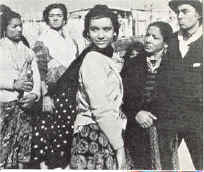 Much of the
flamenco dance seen in the Bay Area today falls under the category of
"tourist flamenco". Most of it consists of poorly-performed sevillanas
lacking ‘duende’, the ephemeral shadow into which great flamenco must cast
itself in order to bond with the tradition of the past (OK I’ll admit it, Bay
Area belly-dancing is worse; one wants to scream "put it back on!" as
our local amateurs insist on exposing their audiences to things better left
hidden. But I digress...). The problem may be in not embracing the ‘Cante
Jondo’ the great and terrible deep songs, the soleares, the seguiriyas, and
other forms that equate flamenco with the tragedies that surround the Andalucian
dynamic. Such tragedies are many, oftentold, and are chronicled in the poetic
form known as the ‘copla’; there is death, drink, romance, and unrequited
love, even the terrible sense of loss remaining from when the Jews were kicked
out of Spain (‘peteneras’). Some of the ‘duende’ has been captured by
Carlos Saura’s films (e.g. ‘Blood Wedding’) featuring the magnificent
dancing of Antonio Gades, they are well crafted, highly polished, and, like
great flamenco, have unhappy endings. What they lack, however, is the rawness
that is essential to the best flamenco, the legacy carried by Juan Breva, Niña
de los Peines, Bernarda de Utrera; the power of such stripped-down,
blood-drenched emotions is difficult to capture on film, but somehow, Carmen
Amaya and her troupe managed to do it in tonight’s film, ‘Los Tarantos’ .
Much of the
flamenco dance seen in the Bay Area today falls under the category of
"tourist flamenco". Most of it consists of poorly-performed sevillanas
lacking ‘duende’, the ephemeral shadow into which great flamenco must cast
itself in order to bond with the tradition of the past (OK I’ll admit it, Bay
Area belly-dancing is worse; one wants to scream "put it back on!" as
our local amateurs insist on exposing their audiences to things better left
hidden. But I digress...). The problem may be in not embracing the ‘Cante
Jondo’ the great and terrible deep songs, the soleares, the seguiriyas, and
other forms that equate flamenco with the tragedies that surround the Andalucian
dynamic. Such tragedies are many, oftentold, and are chronicled in the poetic
form known as the ‘copla’; there is death, drink, romance, and unrequited
love, even the terrible sense of loss remaining from when the Jews were kicked
out of Spain (‘peteneras’). Some of the ‘duende’ has been captured by
Carlos Saura’s films (e.g. ‘Blood Wedding’) featuring the magnificent
dancing of Antonio Gades, they are well crafted, highly polished, and, like
great flamenco, have unhappy endings. What they lack, however, is the rawness
that is essential to the best flamenco, the legacy carried by Juan Breva, Niña
de los Peines, Bernarda de Utrera; the power of such stripped-down,
blood-drenched emotions is difficult to capture on film, but somehow, Carmen
Amaya and her troupe managed to do it in tonight’s film, ‘Los Tarantos’ .